


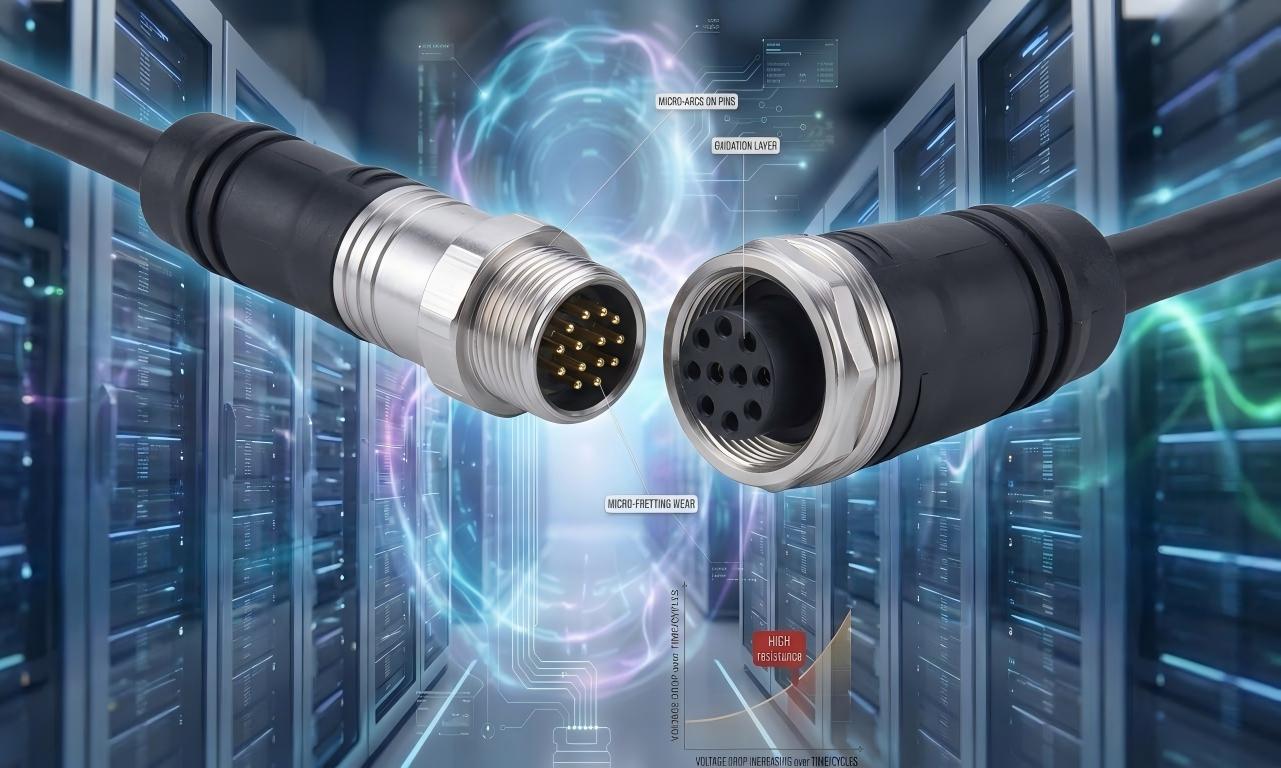
Circular connectors are widely used in industrial automation, robotics, automotive systems, battery equipment, power applications, and other demanding environments. When properly designed and selected, they can provide stable electrical performance throughout their service life.
However, in some applications, voltage drop may gradually increase after a connector has been used for a period of time.
One of the main factors behind this change is an increase in contact resistance at the electrical interface.
Changes in the contact surface, mechanical condition, environmental exposure, and operating conditions can all affect the long-term electrical performance of a circular connector.
Understanding these factors can help engineers select and design connectors with more stable long-term performance.
What Causes Voltage Drop in a Circular Connector?
Voltage drop occurs when electrical current passes through resistance within the connection path.
In a circular connector, the contact interface is an important part of this electrical path. If the contact condition changes over time, the resistance at the interface may also change.
As a result, the voltage available to the connected equipment may decrease.
The main factors that can contribute to increased voltage drop include:
- Contact wear
- Oxidation or contamination
- Loss of contact force
- Repeated mating and unmating
- Excessive temperature
- Vibration and mechanical movement
- Improper contact design
- Connector overloading
These factors may occur individually or together depending on the application environment.
Why Does Voltage Drop Increase Over Time?
The electrical performance of a connector can change as its contact interface is exposed to mechanical, thermal, and environmental stresses.
A connector that performs normally when new may experience changes after long-term use if the contact surfaces become worn, contaminated, oxidized, or mechanically unstable.
This is why long-term connector reliability depends not only on the initial electrical performance but also on how well the contact system maintains its condition during service.
1. Contact Wear
Repeated mating and unmating can gradually wear the contact surfaces.
During each mating cycle, the contact surfaces move against each other. Over time, this mechanical interaction may affect the contact surface and its ability to maintain stable electrical contact.
Excessive wear may result in:
- Reduced effective contact area
- Changes to the contact surface
- Reduced contact stability
- Increased contact resistance
For applications involving frequent connection and disconnection, the expected mating frequency should therefore be considered during connector selection.
2. Oxidation and Surface Contamination
The contact interface can be affected by moisture, dust, chemicals, and other contaminants.
Oxidation or contamination may reduce the quality of the electrical contact and contribute to increased contact resistance.
This can be particularly important in:
- Outdoor equipment
- Industrial automation
- Marine applications
- Automotive environments
- High-humidity environments
Suitable contact materials, plating, and connector protection can help reduce the impact of environmental exposure.
3. Loss of Contact Force
Stable electrical contact depends on maintaining sufficient contact force between mating surfaces.
Over time, contact force may be affected by mechanical fatigue, repeated mating, thermal cycling, vibration, or material deformation.
If the contact force becomes insufficient, the electrical connection may become less stable and contact resistance may increase.
For this reason, contact spring design and material selection are important considerations for long-term connector reliability.
4. Repeated Mating and Unmating
Frequent mating and unmating can gradually affect the contact surfaces.
Each mating cycle creates mechanical movement between the contacts. Over time, this may contribute to contact wear and changes in electrical performance.
For applications requiring frequent connection and disconnection, the connector’s mating-cycle capability should be evaluated according to the actual application requirements.
5. Excessive Temperature
Temperature is another factor that can influence connector performance.
When a connector carries current, some heat is naturally generated at the electrical connection points. If the connector operates under excessive current or inadequate thermal conditions, the resulting temperature increase may accelerate contact degradation.
Long-term exposure to elevated temperatures can affect:
- Contact materials
- Plating
- Contact force
- Insulating materials
- Overall connector reliability
For high-current applications, electrical and thermal performance should therefore be considered together.
6. Vibration and Mechanical Movement
Circular connectors used in robotics, vehicles, industrial machinery, and other moving equipment may experience continuous vibration or movement.
Mechanical movement can gradually affect the contact interface and may contribute to:
- Contact wear
- Fretting
- Reduced contact stability
- Changes in contact resistance
A suitable locking mechanism, contact structure, strain relief, and cable design can help maintain connection stability in these applications.
7. Connector Overloading
Operating a connector beyond its intended electrical capacity can increase thermal and mechanical stress on the contact system.
Excessive electrical loading may accelerate contact degradation and affect long-term performance.
Therefore, connector selection should consider the actual operating current, cable specification, ambient conditions, installation method, and thermal environment rather than relying only on a nominal connector rating.
How Does Contact Plating Affect Long-Term Performance?
Contact plating plays an important role in protecting the contact surface and maintaining stable electrical performance over time.
Gold-plated contacts are widely used in circular connectors, particularly in industrial and other demanding applications where stable electrical contact, corrosion resistance, and long-term reliability are important.
Gold plating can help protect the contact surface from oxidation and environmental exposure while maintaining a stable contact interface during service.
The performance of a plated contact also depends on factors such as:
Plating thickness
Contact base material
Contact force
Mating frequency
Operating environment
Temperature
Mechanical wear
For circular connectors, the plating specification should therefore be selected together with the overall contact design and application requirements.
How Can Voltage Drop Problems Be Reduced?
Several design and application considerations can help maintain stable electrical performance over time.
Select the Appropriate Contact Design
The contact structure should provide stable electrical contact while meeting the mechanical requirements of the application.
Choose Suitable Contact Materials and Plating
Material and plating should be selected according to the electrical, mechanical, and environmental requirements.
Avoid Excessive Electrical Loading
The connector should be selected according to the actual application conditions and operated within its intended range.
Protect the Contact Interface
For demanding environments, appropriate sealing and connector protection can help reduce the effects of moisture, dust, and contaminants.
Consider Mechanical Conditions
Vibration, cable movement, mating frequency, and mechanical stress should all be considered when selecting the connector.
Evaluate Long-Term Performance
Connector evaluation should not focus only on initial electrical performance. Where necessary, testing should also consider environmental exposure, mechanical cycling, temperature conditions, and other application-specific factors.
How to Select a Circular Connector for Stable Long-Term Performance
When selecting a circular connector, consider more than its initial electrical performance.
Important factors include:
- Rated current
- Contact design
- Contact material
- Plating
- Mating requirements
- Operating temperature
- Vibration and mechanical movement
- Environmental conditions
- Sealing requirements
- Connector locking mechanism
- Cable size
- Installation conditions
A connector suitable for one application may not be suitable for another. The electrical, mechanical, and environmental requirements should therefore be evaluated together.
Conclusion
An increase in voltage drop in a circular connector over time is often related to changes in the contact interface.
Contact wear, oxidation, contamination, reduced contact force, repeated mating, temperature, vibration, and excessive electrical loading can all affect contact resistance and long-term electrical performance.
For demanding applications, reliable connector performance requires more than simply selecting a connector with a suitable current rating. Contact structure, materials, plating, environmental protection, thermal conditions, and mechanical design should all be considered together.
At Yuanyue Electronics, we provide customized circular connectors and cable assembly solutions for industrial automation, robotics, automotive, new energy, battery systems, and other demanding applications. Our engineering team can evaluate contact structure, electrical requirements, plating options, cable specifications, and environmental conditions to develop suitable connector solutions for different applications.
1. What causes voltage drop in circular connectors?
Voltage drop can be affected by resistance within the electrical connection path. Changes in the contact interface over time may increase resistance and contribute to greater voltage drop.
2. Why can contact resistance increase over time?
Contact resistance may change due to contact wear, oxidation, contamination, loss of contact force, repeated mating, vibration, temperature, or other operating conditions.
3. Can connector temperature affect voltage drop?
Yes. Temperature can affect contact materials and the mechanical condition of the contact interface, potentially influencing electrical performance over time.
4. Does contact plating affect long-term connector performance?
Yes. Contact plating can influence corrosion resistance, wear resistance, and the stability of the contact interface. The appropriate plating depends on the specific application requirements.
5. How can I reduce voltage drop problems in a circular connector?
Select a connector with a suitable contact design and electrical capacity, use appropriate materials and plating, protect the contact interface from environmental contamination, and consider the application’s temperature, vibration, mating frequency, and mechanical conditions.
