


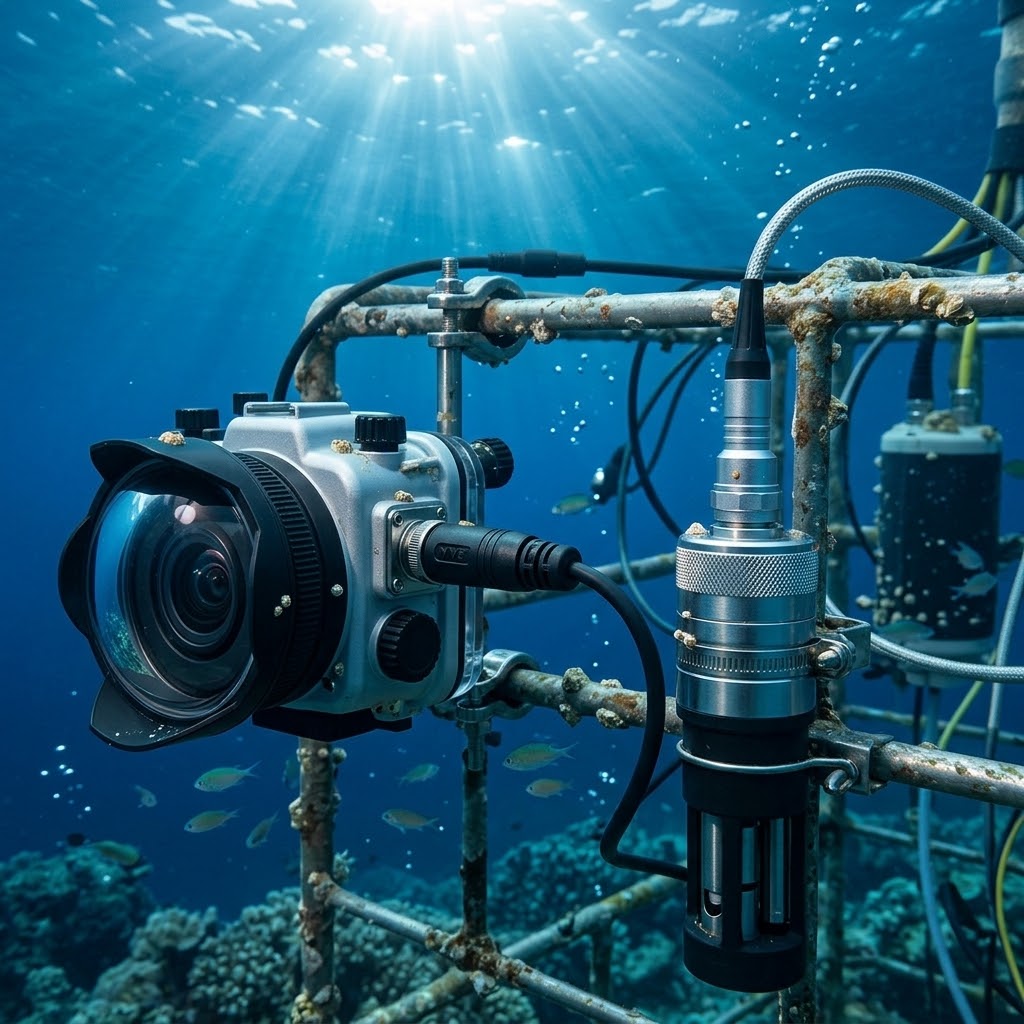
Designing Waterproof Cable Assemblies for Marine Aquaculture Monitoring Equipment
Marine aquaculture—including offshore fish farming cages, water quality monitoring buoys, subsea camera systems, and automated feeding platforms—relies heavily on real-time data collection in demanding marine environments. However, deployment in saltwater subjects electronic interconnections to continuous mechanical stress, severe galvanic corrosion, aggressive biofouling, and extreme hydrostatic pressure. A standard “waterproof” cable or connector will quickly fail under these prolonged conditions, leading to costly equipment downtime and sensor damage.
To ensure multi-year operational reliability, engineers must approach subsea interconnects through a comprehensive framework that integrates material science, mechanical strain relief, hydrostatic sealing, and rigorous quality assurance. This guide explores the essential design principles for manufacturing robust, marine-grade IP68/IP69K cable assemblies.
1. Achieving True IP68 / IP69K Long-Term Submersion
Achieving a reliable seal underwater involves more than simply installing standard O-rings. The design must accommodate constant pressure differentials and high-pressure maintenance routines.
IP68 Depth Rating vs. Dynamic Submersion
Unlike standard IP68 ratings—which are typically defined for short durations at shallow depths—marine aquaculture monitoring equipment requires continuous submersion at specific depth pressures (e.g., 50 meters / 5 bar for over 72 hours). Connectors and overmolded boots must maintain seal integrity under both static pressure and dynamic flexing caused by ocean currents.
IP69K Protection for High-Pressure Washdowns
Aquaculture monitoring buoys and cage frames accumulate organic buildup that requires periodic cleaning with high-pressure, hot-water sprayers. An IP69K rating ensures the cable assembly can withstand close-range washdowns (up to 100 bar at 80°C) without seal displacement or water intrusion.
Anti-Wicking & Water-Blocking Construction
If a cable jacket is accidentally cut or punctured by marine debris or maintenance tools, seawater can travel down the internal conductor strands via capillary action—a phenomenon known as “wicking.” To mitigate this risk, specialized subsea cables incorporate water-blocking compounds, potted internal junctions, or pressure-resistant blocking gels that seal individual conductors, preventing fluid migration to the host electronics.
2. Material Selection: Biofouling & Corrosion Resistance
Selecting the right materials for outer jackets, metallic components, and contact pins determines whether a cable assembly lasts months or years in saltwater.
| Component | Standard Material (Not Suitable) | Recommended Marine Grade Material | Key Performance Benefit
|
| Cable Jacket | Standard PVC / Polyethylene | Polyether-based PUR / TPE | Superior hydrolysis resistance, anti-tear, low biofouling adhesion |
| Connector Housing | Anodized Aluminum / Brass | 316L Stainless Steel / Marine Bronze | High resistance to pitting and galvanic corrosion in saltwater |
| Contact Pins | Flash Gold Plated Brass | 30µ” Gold-Plated Phosphor Bronze | Prevents oxidation and maintains micro-volt signal integrity |
| Sealing O-Rings | Standard NBR (Nitrile) | FKM (Viton) / Silicone / EPDM | Long-term resistance to salt, UV degradation, and bio-cleaning agents |
Preventing Biofouling Damage
Marine organisms such as barnacles, mussels, and algae readily attach to underwater cables. As these organisms grow, their rigid shells cut into soft cable jackets when moved by currents. Using smooth, low-surface-energy polyether-based polyurethane (PUR) outer jackets significantly reduces barnacle attachment strength and resists hydrolytic degradation caused by micro-organisms.
Corrosion Protection & Contact Integrity
Saltwater acts as an aggressive electrolyte, promoting rapid galvanic corrosion between dissimilar metals. Overmolded connectors should use 316L stainless steel hardware or specialized marine bronze. Internal contacts must feature thick gold plating (at least 30 micro-inches) to prevent pin oxidation and maintain stable sensor data transmission.
3. Mechanical Strain Relief in Dynamic Ocean Currents
Subsea monitoring platforms encounter continuous cyclic stress from wave motion and underwater currents. Mechanical design must protect the delicate internal conductor terminations from pulling forces.
Kevlar (Aramid) Strength Members: Integrating central Kevlar braided cores allows the cable assembly to handle pull loads exceeding 100 kg, preventing structural strain on soldered or crimped conductor joints.
Graduated Overmolded Strain Relief: A multi-stage, flexible strain relief boot transitions the bend radius smoothly from the rigid connector coupling to the flexible cable, preventing sharp bending points that cause conductor fatigue.
Anti-Twist & Keying Mechanisms: Heavy-duty mechanical locking nuts and keyed alignment slots prevent rotational torque from twisting internal wires during field installation.
4. Testing & Quality Assurance Standards
To guarantee zero-defect performance in remote aquaculture sites, custom marine cable assemblies must undergo rigorous 100% factory testing before shipment.
Key Quality Verification Tests:
– Helium Leak & Airtightness Testing: Detects micro-voids in overmolds and potted junctions prior to water immersion testing.
– Hydrostatic Pressure Testing: Simulates targeted depth pressures (e.g., 10–50 meters) in specialized pressure chambers.
– Salt Spray Chamber Testing: Exposes metallic components to 168+ hours of continuous salt fog to verify corrosion protection.
– Insulation Resistance (IR) & High Voltage Testing: Ensures dielectric strength between conductors at >100MΩ under wet conditions.
5. Frequently Asked Questions (FAQ)
Q1: What is the difference between standard IP68 and marine-grade IP68 for underwater cables?
A1: Standard IP68 leaves exact depth and duration parameters to the manufacturer (often tested at 1.5 meters for 30 minutes). Marine-grade IP68 specifies continuous deep-water submersion conditions (e.g., 20–100 meters for months or years) alongside dynamic pressure fluctuations caused by underwater currents.
Q2: Why is polyether-based PUR preferred over PVC for marine aquaculture applications?
A2: Standard PVC degrades through hydrolysis when continuously submerged in water, becoming brittle and cracking over time. Polyether-based PUR offers exceptional hydrolysis resistance, superior tear strength against biofouling shells, and remains flexible in cold seawater.
Q3: How does anti-wicking technology protect marine monitoring systems?
A3: If an outer cable jacket is damaged by ship propellers or sharp barnacles, water can enter the cable and act like a straw (wicking) into the expensive electronic housing. Anti-wicking cables use internal water-blocking gels or potted block barriers that stop fluid migration even if the outer jacket is compromised.
Q4: Can custom overmolded cable assemblies be retrofitted to existing subsea sensors?
A4: Yes. Custom cable manufacturers can design tailored overmolded boots, adapter housings, and connector pinouts (such as M12, M16, or custom circular types) to match existing sensor interfaces while upgrading the cable assembly to marine-grade durability.
Conclusion & Next Steps
Designing cable assemblies for marine aquaculture monitoring requires balancing material compatibility, dynamic mechanical strength, and pressure-proof sealing. By selecting polyether PUR jackets, 316L stainless steel hardware, and implementing anti-wicking potting, manufacturers can deliver long-term reliability in severe ocean conditions.
Partner with Dongguan City Yuanyue Electronics Co., Ltd. for Custom Marine Cable Assemblies
Looking to upgrade your underwater monitoring equipment with custom IP68/IP69K waterproof wire harnesses? Contact our engineering team today for DFM analysis, sample prototyping, and custom interconnect solutions tailored to your technical specifications.
