


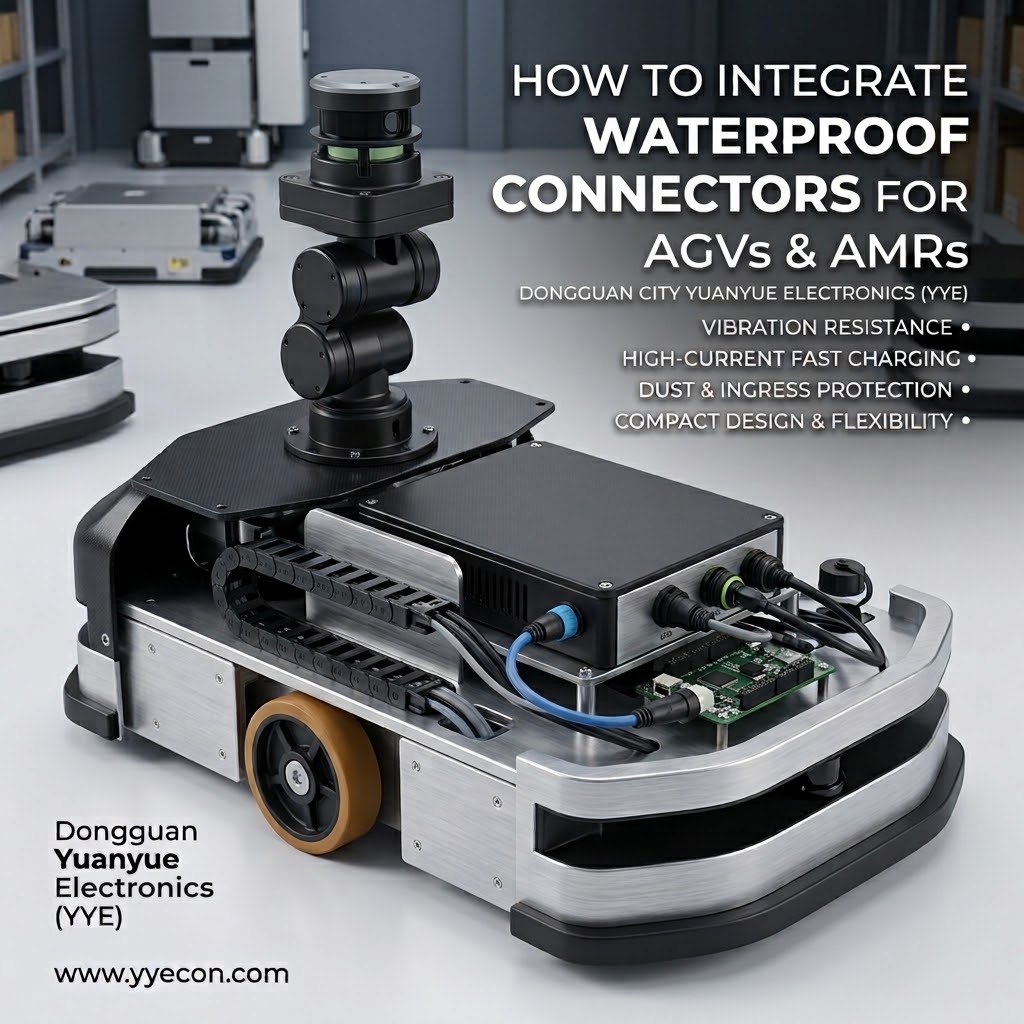
How to Select Waterproof Connectors for AGVs and AMRs in Automated Warehouses
In modern automated warehouses, Autonomous Guided Vehicles (AGVs) and Autonomous Mobile Robots (AMRs) operate continuously to handle logistics sorting, and material transport tasks. While these robots boost overall operational efficiency, their internal electronic components are exposed to severe operating stresses, including persistent vibration, high-current fast charging, tight space constraints, and airborne dust in the warehouse environment.
Selecting appropriate industrial waterproof connectors and cable assemblies is critical to preventing unplanned downtime and extending the service life of equipment. In this guide, we detail the core engineering considerations for selecting interconnect solutions for warehouse AGVs and AMRs.
1. Vibration & Shock Resistance: Choosing the Right Locking Mechanism
AGVs and AMRs constantly navigate uneven floor joints, ramp inclines, and sudden start-stop cycles. Over time, constant micro-vibrations can loosen standard push-fit connectors or cause intermittent contact resistance spikes.
To ensure continuous power and signal transmission, selecting an appropriate locking mechanism is critical.
Connector Locking Mechanisms Comparison
| Locking Type | Vibration Resistance | Mating Speed | Dust/Water Protection | Best Suited AGV Application |
| Threaded Coupling (M8 / M12) | Very High (with ratchet/anti-vibration mechanism) | Moderate | Up to IP67 / IP68 / IP69K | Main power, sensor buses, motor drives |
| Push-Pull Quick Locking | High | Fast | Up to IP67 | Modular payload attachments, quick-swap batteries |
| Bayonet Locking | High | Fast (1/4 turn) | Up to IP67 / IP68 | Diagnostic ports, external communication interfaces |
Engineering Tip: For high-vibration chassis areas, specify circular connectors featuring an anti-vibration ratchet locking mechanism or spring-loaded pin contacts (such as crown spring terminals) to guarantee uninterrupted electrical contact.
2. High-Current & Fast-Charging Interconnects: Thermal Management & Pin Durability
As automated warehouses transition toward continuous 24/7 operation, AGVs and AMRs increasingly rely on high-rate opportunity charging (10A to 50A+) during short stationary intervals. These rapid charge cycles subject internal power connectors to localized resistive heating and significant thermal cycling.
Contact Resistance & Advanced Plating: Standard brass terminals often degrade under continuous high current due to contact surface oxidation. To maintain low contact resistance (less than 5 mΩ) and prevent localized hot spots, power pins should feature heavy gold plating over nickel or specialized silver-plated crown spring (hyperboloid) designs. This reduces friction during high mating cycles while ensuring maximum current transfer.
Thermal Dissipation & De-rating Curves: Connectors must be evaluated based on their temperature rise curves. Inside a sealed, compact robot chassis, internal ambient temperatures can easily exceed 50°C. Engineers should select connectors with a rated temperature capacity of at least 105°C or 125°C, applying proper current de-rating to ensure safe continuous operation.
Hybrid Power & Signal Integration: Integrating high-amperage power lines with sensitive communication buses (such as CAN, EtherCAT, or RS-485) into a single hybrid circular connector drastically reduces panel footprint. However, proper internal shielding and grounding designs are essential to prevent electromagnetic interference (EMI) from high charging currents from corrupting control signals.
3. Dust & Environmental Ingress Protection: Beyond Simple Water Resistance
While warehouses are sheltered indoors, they are far from clean or temperature-controlled. Constant material movement generates ambient cardboard fiber dust, static-charged packaging debris, and localized humidity fluctuations. Furthermore, automated guided vehicles (AGVs) traveling between ambient packaging areas and cold-storage facilities face severe moisture-related challenges.
Dual-Barrier Dust & Moisture Protection (IP67 / IP68 / IP69K): Fine packaging dust can insidiously creep into unsealed connector housings, causing premature terminal wear or micro short circuits. An IP67 rating guarantees complete dust-tight performance and resistance to temporary water submersion. For robots exposed to high-intensity washdown procedures (such as those in food and pharmaceutical cold chains) or operating at outdoor loading docks, upgrading to IP68 (rated for prolonged submersion) or IP69K (rated for high-pressure, high-temperature washdown) is strongly recommended.
Cold-Chain Condensation and Seal Elasticity: In sub-zero cold-chain warehouses (down to -30°C), standard nitrile (NBR) or PVC seals lose elasticity, become brittle, and shrink—resulting in a total loss of ingress protection. Connectors engineered for low-temperature autonomous mobile robots (AMRs) must integrate low-compression-set silicone or fluoroelastomer (FKM) O-rings. These materials retain mechanical flexibility and consistent sealing force across wide temperature fluctuations, preventing internal condensation from triggering short circuits during temperature transitions.
4. Compact Design & Cable Flexibility for Tight Enclosures
The internal chassis of an Autonomous Mobile Robot (AMR) is a densely packed space that accommodates drive motors, steering actuators, battery management systems (BMS), safety LiDAR, and main controller units. Space constraints require thoughtful connector routing and effective strain relief design.
Spatial Efficiency Enabled by Right-Angle Panel Mounts
Straight connector plugs typically require considerable bend clearance space behind or outside the robot frame. Adopting 90-degree right-angle receptacles and low-profile molded plugs minimizes the axial footprint, enabling tight-clearance routing along the internal aluminum extrusion frame or chassis wall.
High-Flex Cabling & Molded Strain Relief
Cable assemblies connected to dynamic components—such as lifting mechanisms, steering pivots, or suspension arms—undergo millions of flex cycles throughout their service life. Combining TPU-jacketed high-flex drag-chain cables with overmolded strain-relief boots diverts mechanical bending forces away from the connector termination point, preventing internal wire strand fatigue, jacket tearing, and IP seal degradation.
5. Coding & Keying Design: Reducing Maintenance and Assembly Errors
With dozens of complex wiring harnesses packed inside a single robot, manual assembly errors during mass manufacturing or field servicing can cause costly board burnouts or communication failures.
Standardized Coding Options for Multi-Bus Architecture
Implementing industry-standard mechanical keying prevents cross-mating of adjacent lines with identical pin counts:
– A-Code: Dedicated to general DC power, sensor connections, and I/O signals.
– B-Code / K-Code: Ideal for fieldbus systems (PROFIBUS) and AC/DC power extensions.
– D-Code & X-Code: Critical for high-speed industrial Ethernet protocols (EtherCAT, PROFINET, Gigabit Ethernet) that require 360-degree continuous EMI shielding.
Pre-molded Cable Assemblies vs. Field-Wireables
While field-wireable connectors enable quick on-site repairs, factory overmolded cable assemblies deliver superior strain relief, consistent IP68 sealing, and true plug-and-play installation. Pre-molded harnesses also eliminate human error in wiring and significantly shorten assembly line production times for AGV/AMR OEMs.
Frequently Asked Questions (FAQ)
Q1: Why are M12 circular connectors so popular in AGV/AMR designs?
A: M12 connectors offer a compact footprint, excellent mechanical strength, and standardized keying options (A, B, D, X-Code). Their robust threaded coupling and high IP ratings (IP67/IP68) make them an industry standard for sensor networks, CANbus, and Ethernet communication in industrial robotics.
Q2: What IP rating is recommended for warehouse robotics connectors?
A: At a minimum, IP67 is recommended to keep fine packaging dust and moisture out. For AGVs operating in outdoor transition zones, cold storage, or areas subject to high-pressure cleaning, an IP68 or IP69K rated connector is preferred.
Q3: How do cold-storage environments affect connector seals?
A: Sub-zero temperatures can cause standard rubber or PVC seals to harden, shrink, and crack, leading to a loss of ingress protection. Connectors designed for cold-chain AGVs should use specialized low-temperature silicone or fluoroelastomer (FKM/Silicone) O-rings to retain seal elasticity.
Q4: Can power and signal lines be combined into a single waterproof connector?
A: Yes. Hybrid circular connectors integrate both high-current power contacts and high-density signal pins into one compact housing, saving panel space and simplifying cable routing inside the robot.
Reliability Built for Modern Logistics Automation
Choosing the right waterproof connector requires balancing mechanical durability, thermal capacity, environmental sealing, and ease of maintenance.
At Dongguan City Yuanyue Electronics Co., Ltd. (YYE), we specialize in high-reliability industrial circular connectors, custom wire harnesses, and overmolded cable solutions designed to withstand the toughest industrial environments.
Looking to optimize your AGV/AMR wiring system? Contact our engineering team today to request technical datasheets or custom sample designs.
