


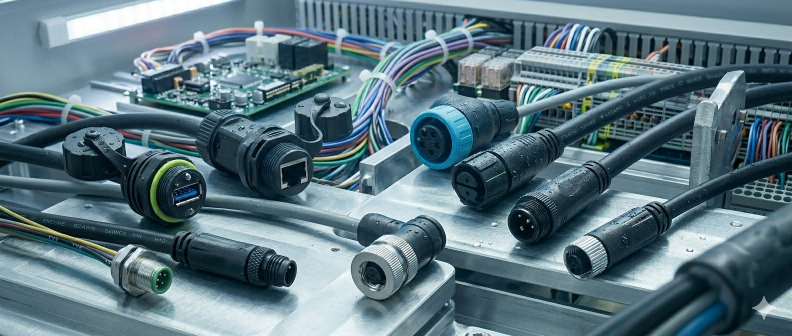
In harsh environments such as high salt spray and extreme temperatures, should circular connectors use metal or plastic housings?
When designing components for marine electronics, solar/new energy storage (BESS), high-voltage power grids, or outdoor communication systems, the most classic debate faced by R&D and procurement teams is: should waterproof circular connectors have metal or plastic housings?
When facing harsh operating conditions such as high salt spray, intense sunlight, and extreme temperature differences, choosing the wrong material can cause the entire system to completely fail within a few months due to water ingress, cracking, or signal interruption. This article will provide an in-depth analysis of the extreme performance and core selection criteria of these two materials from an industrial practice perspective.
Introduction
Traditionally, many people believe that “metal is always better than plastic, and expensive is always better than cheap.” However, this rule is being broken in the modern industrial fluid and electrical connection fields. With technological breakthroughs in modified engineering plastics, plastic casings are even outperforming metals in many harsh environments. The essence of selection is not about comparing which is more advanced, but about achieving a perfect balance between the physical properties of the material and the destructive forces of the environment.
1. Which has a longer lifespan: metal or plastic?
A. For plastics, aging is the biggest enemy.
The main reasons for the shortened lifespan of plastics are that ultraviolet radiation, high-temperature oxidation, and acid and alkali corrosion cause molecular chain breakage, resulting in brittleness, cracking, and deformation. Modifying raw materials can significantly improve aging resistance: adding antioxidants to block oxidation, adding UV absorbers to resist light, and using carbon black as a filler to block ultraviolet rays can extend the lifespan of outdoor plastics from 1-3 years to 8-15 years. Properly protecting plastics from light and corrosive environments during use can also effectively extend their lifespan.
B. For metals, corrosion and fatigue are the main challenges.
With proper protection, metals can have a very long lifespan: 316 stainless steel is the first choice for high-salt-spray coastal environments, while hot-dip galvanized steel is the preferred choice for regular outdoor use. When combined with surface protection such as fluorocarbon coatings, the outdoor lifespan can reach several decades. Shot peening can further improve fatigue resistance and reduce the risk of stress cracking.
2. Which is more suitable for prolonged outdoor exposure: metal or plastic?
In outdoor environments with prolonged exposure to sunlight, metal materials are strongly recommended for overall performance, whereas plastics are suitable only for low requirements or temporary applications. The key differences between the two lie in their resistance to aging, stability, and applicable scenarios, as detailed below:
Ultraviolet radiation is the primary culprit of outdoor aging, and the mechanisms and manifestations between the two differ significantly:
Plastics: Ultraviolet radiation directly damages the polymer chains of plastics, leading to chain breakage and ultimately resulting in yellowing, brittleness, and cracking. Conventional PP/PE plastics exhibit significant aging and failure within just six months under eight hours of daily sunlight exposure. Even modified HDPE containing UV stabilizers has a service life of only 5–8 years, whereas materials with poor weather resistance, such as ABS, rapidly develop surface powdering.
Metals: Most metals are inherently resistant to UV damage. Aluminum alloys, in particular, reflect most sunlight; with special surface treatment, they do not fade or deform even under prolonged exposure to sunlight. Their excellent thermal conductivity enables rapid heat dissipation, preventing internal heat accumulation. After surface treatment, stainless steel can withstand long-term UV exposure without discoloration or rusting, making it the material with the strongest overall weather resistance for sun-exposed applications.
3. Comparison of Core Parameters for Different Materials
| Comparison Dimension | Metal housing (316 stainless steel) | Standard engineering plastic housing |
| Salt spray resistance | No corrosion for 96–1000 hours | The degradation period is typically ≤72 hours, while ordinary plastics exhibit failure after six months. |
| Applicable Temperature Range | -65℃~+200℃ | –25°C to +85°C (special plastics can withstand up to +120°C) |
| shock strength | More than five times that of plastic | Low; long-term vibration may lead to cracking. |
| EMC shielding properties | Natural Faraday cage with maximum shielding capability of 120 dB+ | Conductive filler needs to be added; the shielding effect is limited |
| Insulation Safety | Additional insulation treatment is required. | Comes with insulation; no lightning protection required for installation. |
| Weight and Cost | High weight and high unit price | Lightweight and cost-effective |
| life length | With proper maintenance, its durability can reach 3 to 5 times that of plastic. | Shorter lifespan under harsh environmental conditions; prone to aging |
4. Is weight an overlooked issue?
Weight is often an overlooked factor in connector selection, but for lightweight applications such as drones, mobile robots, and medical devices, a metal circular connector can be 2-3 times heavier than its plastic counterpart. In the long run, this directly impacts device battery life, operational efficiency, and center of gravity. Especially in battery-powered systems, any extra weight will be amplified into an energy consumption burden, thus shortening the single-use time.
In highly dynamic applications, such as AGVs and AMR robots, changes in weight distribution can affect acceleration performance and steering stability, requiring additional compensation in the overall control strategy. Therefore, in these energy- and structurally sensitive applications, lightweight connector design is often as important as reliability, and in some projects, it even becomes one of the key factors in the final selection.
5. How to make the final choice? Core selection decision principles
A. Scenarios where a metal casing must be selected
In the following typical harsh environments, a metal casing is the only reliable option:
High salt spray corrosion environments: For applications such as coastal photovoltaic projects, marine engineering, and island base stations, 316L stainless steel or nickel-plated brass must be selected. 316L contains molybdenum, which forms a self-healing chromium oxide protective film, offering over 10 times greater resistance to salt spray corrosion than conventional plastics. It typically passes 96-hour salt spray tests, while the military-grade J599 series can even withstand up to 1,000 hours of exposure.
Extreme temperature conditions: When operating temperatures exceed **120°C** or drop below-40°C for extended periods, ordinary plastics may melt or become brittle, while brass can withstand up to 200°C and stainless steel operates within a wide temperature range of-65°C to +175°C; high-temperature military-grade products can even endure temperatures up to +200°C.
High-vibration impact scenarios: applicable to aerospace equipment, industrial stamping presses, crushers, etc. The metal casing exhibits over five times greater impact resistance than plastic, and its threaded locking mechanism is more robust than plastic fasteners, preventing cracks or poor contact due to prolonged vibration.
High electromagnetic interference environment: Aviation radars and industrial communication equipment require EMC shielding. The metal casing inherently creates a Faraday cage effect, and combined with a 360° full shielding design, it achieves a shielding efficacy of up to 120 dB+, meeting the stringent anti-interference requirements of military aviation applications.
B. Scenarios where special engineering plastic casings can be used
If the following conditions are met, a plastic housing can achieve a lighter weight and better cost-effectiveness:
For typical humid or ambient temperature environments—such as outdoor streetlights or office air conditioning systems with long-term temperatures below 100°C and minimal vibration—Grade F1 outdoor engineering plastics are sufficient, costing only one-third to half that of metal alternatives.
For low-voltage, low-current applications—such as signal connections in outdoor energy storage systems—using SABIC flame-retardant engineering plastics ensures **≥72 hours of salt spray resistance**, wide temperature tolerance from-40°C to +120°C, and compliance with UL94 V-0 flame retardancy standards, making it suitable for most conventional outdoor environments.
C. Additional recommendations for selection in special scenarios
High-frequency signal transmission applications: Composite material (thermoplastic/thermosetting) plastic enclosures exhibit a lower dielectric constant, making them more suitable than metals for high-frequency signals; they should be preferred when environmental corrosion is not severe.
For general outdoor applications with limited budgets, the aluminum alloy housing offers a balanced solution: lighter than stainless steel and more cost-effective, with surface anodization sufficient for standard salt spray protection, making it suitable for most outdoor industrial equipment.
Long-term immersion scenarios: A metal housing must be selected, as metal welding sealing provides greater reliability; prolonged exposure to plastic will cause swelling and deformation, leading to waterproof failure.
6. Source-Yuan Salt Technology Solution for Preventing Salt Spray Corrosion
Salt spray environments (particularly those containing marine chloride ions) accelerate the electrochemical corrosion of metal enclosures, leading to increased contact resistance or even complete enclosure failure. YYE has addressed this challenge through the following surface treatment and material selection strategies:
A. High-performance housing material and electroplating process: Brass coated with pearl chrome/nickel plating: The YYE standard round connector is made from high-quality brass with a multi-layered electroplating finish (including a nickel base layer followed by pearl chrome coating), offering both wear resistance and effective protection against chloride ions. · 316L stainless steel: For extreme marine environments, YYE provides 316L medical/ocean-grade stainless steel housings; the addition of molybdenum (Mo) significantly enhances resistance to pitting and crevice corrosion.
B. Passivation and Sealing Treatment: After electroplating, an environmentally friendly passivation and nano-sealing process is applied to fill the micro-pores in the coating, significantly improving its performance in salt spray testing (NSS).
C. Rigorous salt spray testing confirms that all YYE’s salt spray-resistant round connectors meet the neutral salt spray requirements of MIL-STD-202 or GB/T 2423.17 standards. Conventional coatings withstand 96 hours of salt spray exposure, while custom variants (e.g., stainless steel or special coatings) endure up to 500 or even 720 hours, ensuring long-term reliability on coastal and offshore platforms.
7. Frequently Asked Questions (FAQ)
Q1: What is the IP68 protection rating of a connector, and how deep can an IP68-rated connector operate underwater?
A: IP68 indicates that the device offers complete dustproof performance and can withstand prolonged water immersion under manufacturer-specified conditions. An IP68 circular connector typically meets requirements for operation at depths of 1.5 to 2 meters with immersion durations ranging from 30 minutes to 24 hours without water ingress; for deep-water applications, YYE provides customized sealing solutions (e.g., for depths exceeding 10 meters).
Q2: What are the salt spray resistance testing standards for circular connectors? How many hours of salt spray testing can YYE products withstand?
A: The industry typically employs GB/T 2423.17 or MIL-STD-202 standards for neutral salt spray testing (NSS). YYE’s standard coatings can withstand up to 96 hours of salt spray testing; customized versions using 316L stainless steel or special anti-corrosion coatings can endure rigorous tests lasting 500 to 720 hours or more.
Q3: When purchasing an IP68-rated salt spray-resistant circular connector, what else should be considered besides the housing?
A: In addition to housing protection, attention must also be paid to the plating quality of the contact pins (e.g., gold plating thickness, typically requiring ≥0.5 μm to ensure low contact resistance), as well as the sealing of the tail cable. It is recommended to use adhesive heat-shrink tubing or tail injection molding in practical applications to achieve comprehensive end-to-end protection.
In selection criteria for harsh environments, both metals and plastics offer distinct high-scoring solutions. Excellent supply chain management achieves an optimal balance between cost-effectiveness and stability while meeting fundamental technical requirements.
Yueyue Electronics (YYE) holds certifications for ISO 9001, ISO 14001, and IATF 16949 (Automotive Grade Quality Management System), supported by a professional manufacturing team of approximately 200 members. Equipped with fully self-developed precision stamping facilities and high-performance injection molding workshops, we deliver not only premium products but also expert guidance in material selection for your new projects.
Looking for the perfect round waterproof connector for your marine equipment or energy storage system? Visit yyecon.com to contact YYE’s sales team—we’ll provide professional technical evaluation, comparative quotes (Benchmark Quote), and sample support!
