


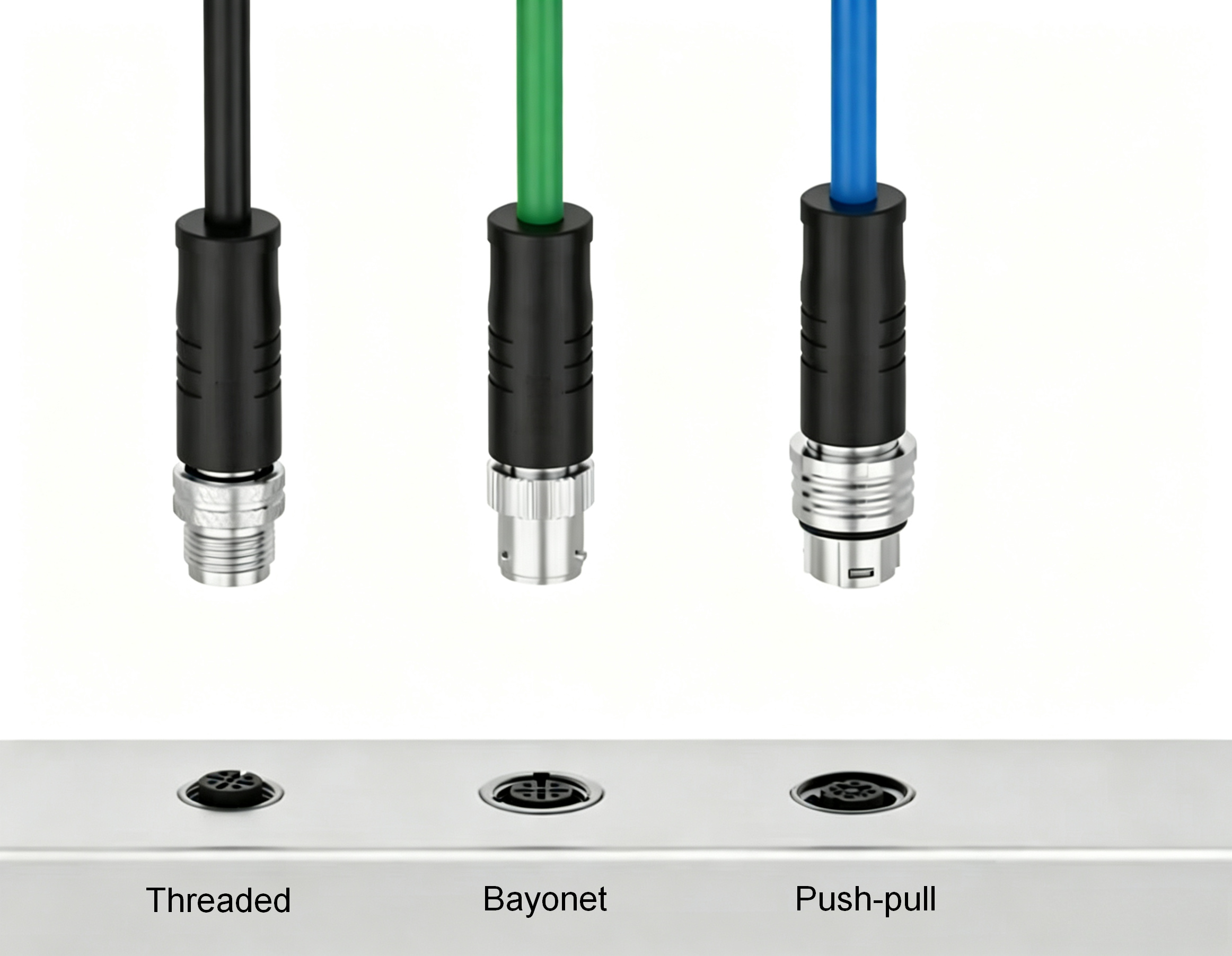
In the Industry 4.0 era, industrial circular connectors are indispensable for delivering rugged and reliable interconnects across electronics and factory automation.
However, whether an electrical connection system can maintain low contact resistance and uninterrupted signal transmission under severe mechanical vibration, thermal expansion, or harsh weather depends entirely on its locking mechanism.
If this mechanism fails, it triggers poor contact, arcing, or intermittent signals, leading to catastrophic production downtime. From an electrical and mechanical engineering perspective, this article deeply analyzes the three mainstream locking technologies—Threaded, Bayonet, and Push-Pull—providing you with a comprehensive selection guide.
1. Threaded Coupling: High Stability & Extreme Protection
Threaded locking (e.g., M8, M12, M23) is the most traditional rigid connection method. It converts rotational torque into a strong axial preload.
-
Pros: Extreme retention force and vibration resistance. It easily achieves IP68/IP69K ratings because the thread provides uniform, continuous pressure on the internal rubber O-ring. High-vibration versions feature an anti-vibration ratchet to prevent loosening.
-
Cons: Slower mating/unmating speed; requires sufficient finger space to rotate the nut; cannot be blind-mated.
-
Applications: Factory automation sensors, automotive high-voltage batteries, heavy machinery.
2. Bayonet Coupling: Quick Mating & Clear Feedback
Bayonet locking uses matching ramps on the receptacle and pins on the plug to overcome the tedious operation of threaded types.
-
Pros: 1/4-turn rapid locking. It offers strong tactile and audible “click” feedback to confirm it is fully locked. It resists high-frequency, low-amplitude vibrations well.
-
Cons: Lower axial pull-out force resistance compared to threads; pins are prone to stress concentration under extreme tension.
-
Applications: Field communication base stations, stage lighting/audio, wireless radio systems.
3. Push-Pull Locking: High Density & Premium Experience
Push-Pull is the ultimate solution for compact device panels and high-density layouts.
-
Pros: Zero-degree rotation. It connects and locks instantly by pushing straight in, and cannot be pulled off by pulling the cable. It is ideal for tight spaces(medical imaging machines or at IO-Link master and hub interfaces).
-
Cons: Complex internal mechanism, higher manufacturing cost; requires protection against accidental sleeve pulling.
-
Applications: Medical devices (endoscopes, monitors), precision test instruments, high-definition broadcast cameras.
4. Core Specification Comparison
| Feature | Threaded | Bayonet | Push-Pull |
| Mating Motion | Push + Multi-turn Rotate | Push + 90°/120° Rotate | Pure Axial Push/Pull (0° Rotate) |
| Mating Speed | ~ 5 – 15 seconds | ~ 1 – 2 seconds | < 0.5 seconds |
| Panel Density | Poor | Medium | Excellent (Ultra-close grouping) |
| IP Rating | IP68 / IP69K (Easy) | IP67 / IP68 | IP50 (Std) / IP68 (Custom) |
| Mating Life | ~ 500 cycles | ~ 500 – 1000 cycles | 2000 – 5000+ cycles |
5. Selection Guide: Choosing the Right Mechanism
Selecting the correct locking mechanism depends on four critical factors:
-
Mating Frequency: Bayonet or Push-Pull is ideal for frequent use, while Threaded is best for long-term, permanent connections.
-
Environmental Conditions: Threaded excels in harsh, dirty, or high-pressure environments; Push-Pull is preferred for clean, compact spaces.
-
Vibration/Shock Requirements: Threaded > Bayonet > Push-Pull for maximum resistance to mechanical stress.
-
Operator Access: Push-Pull fits perfectly in cramped areas; Bayonet works well for fast, one-handed operation; Threaded suits controlled, high-security mating.
By aligning these factors with the unique attributes of each locking mechanism, engineers and buyers can ensure their circular connectors deliver reliable performance throughout the product lifecycle.
About YYE
YYE is a professional circular connector manufacturer dedicated to delivering high-performance connectivity solutions for industrial applications. Driven by strong R&D capabilities and strict quality control, we provide reliable products for automation, energy, and harsh environment applications.
-
IP67/IP68 Waterproof Connectors
-
M5, M8, and M12 Circular Connectors
-
Custom OEM/ODM Solutions
-
Advanced Locking Mechanism Designs
Conclusion
Understanding circular connector locking methods is vital to ensuring reliable field performance. Threaded, bayonet, and push-pull mechanisms each offer unique advantages tailored to specific operational needs.
By choosing the right solution and partnering with a trusted manufacturer like YYE, you guarantee long-term stability, safety, and efficiency for your systems.
To learn more about YYE, please visit:About Us .
To request a quote or get free samples, contact us today at: Contact Us.
Q1: What are the three common locking methods for circular connectors?
A: Threaded, Bayonet, and Push-Pull. Threaded focuses on ruggedness; Bayonet balances speed and feedback; Push-Pull enables ultra-fast, one-handed operation in tight spaces.
Q2: Which locking method is best for high-vibration environments?
A: Threaded locking. It generates a massive axial force to prevent mechanical creep and loosening under continuous impact. Premium versions include an anti-vibration ratchet for extreme conditions.
Q3: What is the main difference between Bayonet and Threaded connectors?
A: Mating speed vs. retention strength. Threaded is more robust against heavy pulling but slower to install. Bayonet mates in seconds with a 90-degree twist and provides a “click” sound when locked, but has lower peak pulling resistance.
Q4: Where are Push-Pull circular connectors typically used?
A: They are widely used in medical electronics (such as endoscopes and monitors), precision testing instruments, and high-end electronic products. These applications require high-density panel layouts and frequent, tool-less, one-handed blind mating because they offer high convenience and precision.
© Yuanyue Electronics — professional circular connector and cable assembly manufacturer
