


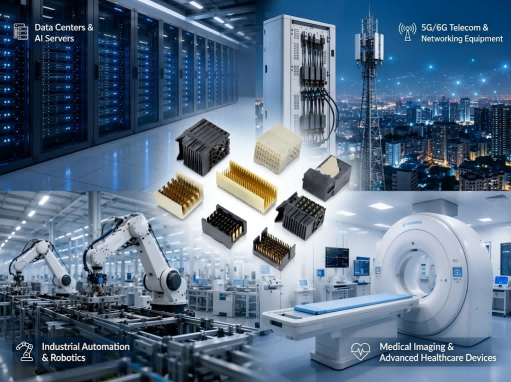
As data centers, AI servers, telecom infrastructure, and networking equipment continue to process increasing amounts of data, the interconnection between internal circuit boards is becoming increasingly important.
In many high-performance electronic systems, multiple functional boards need to communicate through a central backplane. This requires more than simply connecting two PCBs. The connector system needs to support high-speed signal transmission while providing reliable mechanical mating, accurate alignment, and consistent performance during production.
This is where high-speed backplane connector systems play an important role.
The Growing Demand for High-Speed Internal Interconnection
Modern servers, networking switches and telecom equipment are becoming more powerful and increasingly modular. Processing, networking, storage and other functions may be distributed across multiple PCBs within the same system.
A backplane architecture provides a practical way to connect these boards.
Instead of connecting every daughter card directly to another board with separate cables or point-to-point connections, a central backplane can act as an interconnection platform for multiple boards.
This architecture can help equipment manufacturers achieve:
- High-density board-to-board interconnection
- Modular system architecture
- Easier installation and maintenance
- Flexible system expansion
- More organized internal signal routing
As transmission speeds and system density increase, however, the connector itself becomes an increasingly important part of the overall signal path.
How Does a High-Speed Backplane Connector System Work?
A typical backplane architecture consists of a backplane PCB, backplane header and daughtercard/receptacle connector.
The backplane header is mounted on the main backplane, while the corresponding receptacle connector is mounted on the daughter card.
When the daughter card is inserted into the system, the two connectors mate to establish the electrical connection between the daughter card and the backplane.
A simplified structure can be understood as:
Daughter Card
↓
High-Speed Receptacle / Daughtercard Connector
↕
High-Speed Backplane Header Assembly
↓
Backplane PCB
This means the header and receptacle should not necessarily be viewed as two independent components. They work together as a complete mating system within the equipment.
A Complete High-Speed Backplane Connector System
For engineers developing servers, telecom equipment or networking systems, both sides of the connection need to be considered during the design process.
Backplane Side: High-Speed Header Assembly
The backplane header provides the connection interface on the main PCB.
YYE offers a High-Speed Backplane Header Assembly designed for applications including telecom equipment, servers, core routers and data center switches.
It is suitable for equipment architectures where multiple boards need to interface with a central backplane.
Daughtercard Side: High-Speed Receptacle Connector
The daughtercard connector provides the mating interface on the removable or modular board.
YYE’s High-Speed Receptacle / Daughtercard Connector is designed for applications such as telecom backplanes, servers and networking switches.
By combining the daughtercard receptacle with the corresponding backplane header, manufacturers can establish a structured board-to-board interconnection system for high-performance equipment.
What Should Engineers Consider When Selecting High-Speed Backplane Connectors?
Choosing a high-speed connector involves more than checking pin count and mechanical dimensions. The connector needs to work together with the PCB and the rest of the system.
1. Signal Integrity
At higher transmission speeds, the connector becomes part of the overall signal path.
Factors such as impedance discontinuities, insertion loss and crosstalk can influence signal performance. Therefore, the connector design needs to be evaluated together with PCB layout, routing and the intended operating conditions.
For high-speed applications, the connector should be considered as part of the complete interconnection architecture rather than as an isolated component.
2. High Connector Density
Data center servers and networking equipment often need to accommodate more connections within a limited PCB area.
High-density backplane connector systems allow multiple signals to pass between boards while supporting compact equipment architectures.
This can be particularly valuable for:
- High-performance servers
- AI computing systems
- Data center switches
- Telecom equipment
- Core routers
3. Mechanical Alignment
Backplane systems often involve the insertion and removal of daughter cards.
Accurate alignment between the header and receptacle is therefore important for smooth mating and reliable electrical contact.
When multiple connectors are used on the same daughter card, mechanical tolerances and positioning become even more important during equipment assembly.
4. Manufacturing Consistency
For volume production, connector performance also depends on manufacturing consistency.
Dimensional accuracy, terminal positioning, assembly quality and process control can all influence mating performance.
A connector that performs well in prototype testing also needs to maintain consistent characteristics during mass production.
Where Are High-Speed Backplane Connectors Used?
High-speed backplane connector systems are commonly found in equipment where multiple PCBs need to communicate within a compact and modular architecture.
Data Centers and AI Servers
Modern computing platforms require high-density internal interconnection between processing, networking and other functional boards.
Backplane architectures can provide a structured way to connect these modules within a server system.
Telecom and Networking Equipment
Telecom infrastructure and networking equipment often use modular PCB architectures to support different system functions.
High-speed backplane connectors can provide the board-to-board interface between these modules.
Core Routers and Data Center Switches
Core routers and high-performance switches need to move large amounts of data between different processing and networking modules.
A backplane connector system provides the physical interconnection between these boards while supporting high-density equipment designs.
Supporting the Complete Interconnection Requirements
For equipment manufacturers, connector selection is often only one part of the interconnection requirements.
Depending on the product architecture, a project may also require:
- Custom cable assemblies
- Signal cables
- Power cables
- Wire harnesses
- Overmolded assemblies
- Custom connector components
YYE combines connector manufacturing and custom cable assembly capabilities, allowing customers to work with one manufacturing partner for different interconnection requirements.
Our manufacturing capabilities include tooling development, precision metal stamping, plastic injection molding, automated production, connector assembly and cable/wire harness assembly.
This integrated manufacturing capability can be particularly useful for customers developing complex electronic equipment that requires both board-level connectors and cable-based interconnections.
Conclusion
As data centers, AI servers, telecom infrastructure and networking equipment continue to evolve, internal board-to-board interconnection is becoming increasingly important.
A high-speed backplane system brings together the backplane PCB, header assembly and daughtercard receptacle to create a structured connection between multiple functional boards.
For engineers, important considerations include signal integrity, connector density, mechanical alignment and manufacturing consistency.
YYE provides high-speed backplane header assemblies and daughtercard receptacle connectors for telecom equipment, servers, core routers and networking switches, while also supporting custom cable and wire harness requirements.
By combining connector manufacturing with broader interconnection capabilities, YYE can support customers from connector development through production for demanding electronic and communication equipment applications.
1. What are high-speed backplane connectors used for?
High-speed backplane connectors are used to connect multiple PCBs within equipment such as servers, telecom systems, networking switches and data center equipment.
2. What is the difference between a backplane header and a daughtercard connector?
The backplane header is mounted on the main backplane PCB, while the daughtercard connector is mounted on the daughter board. The two connectors mate to establish the board-to-board connection.
3. Why is signal integrity important for high-speed backplane connectors?
At high data rates, the connector becomes part of the signal path. Connector design can affect factors such as impedance, insertion loss, and crosstalk, making signal integrity important for overall system performance.
4. Can high-speed backplane connectors be used in data center and AI server applications?
Yes. High-speed backplane connector systems are suitable for high-density computing platforms, data center servers, AI servers, networking switches, and other equipment requiring high-speed board-to-board interconnection.
5. Can YYE provide both backplane connectors and custom cable assemblies?
Yes. YYE manufactures high-speed connectors and also provides custom cable and wire harness assemblies, allowing customers to source different interconnection components from one manufacturing partner.
