


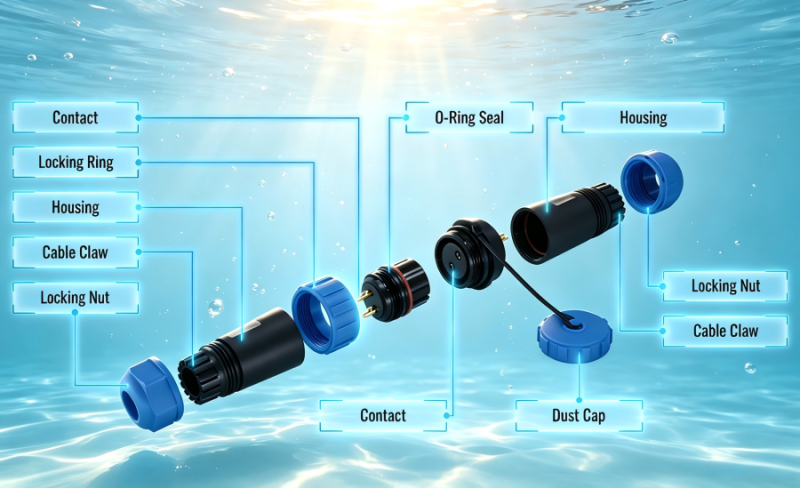
Waterproof circular connectors rely on more than just a threaded coupling or rugged housing to achieve reliable sealing. One of the most critical yet often overlooked components is the O-ring.
Although small in size, an O-ring plays a vital role in preventing water, dust, and contaminants from entering the connector. However, its sealing performance depends heavily on one key design parameter—the O-ring compression ratio.
If the compression ratio is too low, the connector may leak. If it is too high, the O-ring may suffer permanent deformation, making the seal less effective over time.
In this article, we’ll explain why the O-ring compression ratio is critical and how it affects the sealing performance and service life of waterproof circular connectors.
What Is O-Ring Compression Ratio?
The O-ring compression ratio is the percentage by which an O-ring’s cross-sectional diameter is compressed after the connector is fully assembled.
For example, if an O-ring has a cross-sectional diameter of 2.0 mm and is compressed to 1.6 mm after installation, the compression ratio is 20%.
The right compression ratio allows the O-ring to deform sufficiently to fill the sealing gap and create a reliable waterproof barrier without overstressing the sealing material.
Why Is the O-Ring Compression Ratio Important?
1. Ensures Reliable Waterproof Sealing
The O-ring creates a seal by generating contact pressure between the connector housing and the mating surface.
A proper compression ratio enables the O-ring to:
- Fill surface irregularities
- Prevent water ingress
- Maintain sealing under vibration
- Withstand pressure fluctuations
Without adequate compression, even an IP68-rated connector may fail to achieve reliable sealing.
2. Prevents Water Leakage
If the compression ratio is too low, the sealing force may not be sufficient to maintain continuous contact between the O-ring and the sealing surfaces.
This can result in:
- Water leakage
- Moisture entering the connector
- Contact corrosion
- Short circuits
- Reduced connector reliability
Even a high-quality connector cannot perform properly if the O-ring compression ratio is not correctly designed.
3. Prevents Premature O-Ring Failure
An excessively high compression ratio can also reduce sealing performance.
Over-compressed O-rings may experience:
- Permanent deformation (compression set)
- Cracking
- Accelerated aging
- Loss of elasticity
Over time, these issues can reduce sealing effectiveness and shorten the connector’s service life.
4. Extends Connector Service Life
An optimized compression ratio allows the O-ring to maintain its elasticity during repeated assembly, vibration, and temperature changes.
This helps achieve:
- Longer sealing life
- Better resistance to thermal cycling
- Improved long-term reliability
- Lower maintenance costs
What Is the Recommended O-Ring Compression Ratio?
The ideal compression ratio depends on the sealing application, O-ring material, and hardness. However, the following ranges are commonly used in waterproof connector design.
| Application | Recommended Compression Ratio |
|---|---|
| Static sealing | 20–30% |
| Dynamic sealing | 10–20% |
| Waterproof circular connectors | Typically 20–25% |
For most waterproof circular connectors, a compression ratio of 20–25% provides an excellent balance between sealing performance, assembly force, and O-ring durability.
Factors That Affect the O-Ring Compression Ratio
Several design factors determine the final compression ratio after assembly.
O-Ring Material
Different elastomers respond differently to compression.
Common materials include:
- Silicone
- NBR (Nitrile Rubber)
- EPDM
- FKM (Viton)
Material selection influences elasticity, temperature resistance, and long-term sealing performance.
O-Ring Hardness
Harder O-rings require greater sealing force, while softer materials compress more easily.
Selecting the proper hardness helps achieve the desired compression ratio without excessive assembly force.
Groove Design
The dimensions of the sealing groove directly determine the final compression ratio.
A groove that is too deep may reduce sealing effectiveness, while one that is too shallow can over-compress the O-ring.
Manufacturing Tolerances
The dimensional tolerances of both the connector housing and the O-ring influence the actual compression ratio after assembly.
Precision manufacturing is essential for maintaining consistent sealing performance across production batches.
How to Achieve the Correct O-Ring Compression Ratio
To ensure reliable waterproof sealing:
- Select the appropriate O-ring material.
- Design the sealing groove according to industry standards.
- Maintain the recommended compression ratio.
- Avoid excessive tightening during assembly.
- Replace worn or damaged O-rings during maintenance.
- Verify sealing performance through waterproof testing.
Following these practices helps maximize both sealing reliability and connector lifespan.
Conclusion
Although the O-ring is one of the smallest components in a waterproof circular connector, its compression ratio has a significant impact on sealing performance.
A properly designed O-ring compression ratio not only improves waterproof protection but also extends service life, reduces maintenance, and enhances long-term reliability. Whether you are designing a new connector or selecting one for your application, understanding the importance of O-ring compression ratio is essential for achieving dependable sealing performance.
At Yuanyue Electronics, we design and manufacture waterproof circular connectors with carefully optimized sealing structures. By selecting the appropriate O-ring materials, groove dimensions, and compression ratios, we deliver reliable IP67 and IP68 sealing solutions for industrial automation, outdoor equipment, and marine applications.
1. What is an O-ring compression ratio?
The O-ring compression ratio is the percentage by which an O-ring is compressed after assembly to create an effective waterproof seal.
2. What happens if the compression ratio is too low?
A low compression ratio may result in insufficient sealing force, allowing water or dust to enter the connector and reducing overall reliability.
3. Can a compression ratio that is too high damage the O-ring?
Yes. Excessive compression can cause permanent deformation, cracking, and loss of elasticity, shortening the O-ring’s service life.
4. What is the recommended O-ring compression ratio for waterproof circular connectors?
For most waterproof circular connectors, a compression ratio of 20–25% is recommended to achieve reliable sealing while maintaining long-term durability.
5. Which factors affect the O-ring compression ratio?
The compression ratio is influenced by several factors, including O-ring material, hardness, groove dimensions, manufacturing tolerances, and assembly conditions. Proper design and precision manufacturing are essential for consistent sealing performance.
