



How Does Cable Bend Radius Affect Waterproof Circular Connector Reliability?
Waterproof circular connectors are widely used in industrial automation, robotics, marine equipment, outdoor devices, and other applications where reliable electrical connections are required in harsh environments.
While connector sealing structures such as O-rings and cable glands are critical for waterproof performance, the cable bend radius is another important factor that directly affects connector reliability.
Incorrect cable bending can create excessive mechanical stress near the connector exit area, leading to cable damage, sealing failure, and electrical performance issues.
In this article, we will explain what cable bend radius is and how it affects the reliability of waterproof circular cable connectors.
What Is Cable Bend Radius?
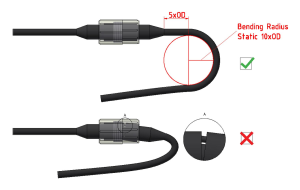
Cable bend radius refers to the minimum radius that a cable can be safely bent without causing damage to the cable structure or affecting its performance.
A larger bend radius means the cable requires more space to bend, while a smaller bend radius allows tighter installation.
For example, if a cable has a recommended minimum bend radius of 10 times its outer diameter, a cable with a 5 mm diameter should not be bent tighter than approximately 50 mm.
Following the correct bend radius helps protect the internal conductors, insulation layers, and shielding structure.
Why Is Cable Bend Radius Important for Waterproof Circular Connectors?
1. Prevents Cable Damage at the Connector Exit Point
The area where the cable enters the connector is one of the most vulnerable points in a cable assembly.
When the cable is bent too sharply:
- Mechanical stress concentrates near the connector outlet
- Conductors may become damaged
- The cable jacket may crack
- Internal wires may break after repeated movement
A properly designed strain relief structure helps distribute bending forces and reduce stress concentration.
2. Protects Waterproof Sealing Performance
Many waterproof circular connectors achieve IP67/IP68 protection through sealing components such as O-rings, cable glands, and overmolded structures.
Excessive cable bending can affect sealing performance by:
- Applying uneven pressure to the cable seal
- Creating gaps between the cable and sealing material
- Damaging the overmolded area
- Allowing moisture to enter the connector
Maintaining the correct bend radius helps preserve long-term waterproof reliability.
3. Improves Connector Service Life in Dynamic Applications
Applications such as robots, automated equipment, and moving machinery often require cables to withstand repeated bending cycles.
If the bend radius is too small, repeated movement can cause:
- Conductor fatigue
- Insulation wear
- Shielding damage
- Intermittent electrical connections
Selecting cables and connectors designed for flexible movement can significantly improve service life.
4. Reduces Stress on Internal Contacts
Cable bending forces can be transferred directly to the connector terminals if proper strain relief is not provided.
This may result in:
- Contact displacement
- Increased contact resistance
- Signal interruption
- Terminal damage
A well-designed strain relief system reduces the mechanical load transferred to the electrical connection area.
Factors That Affect Cable Bend Radius
Cable Construction
Different cable structures have different bending capabilities.
Factors include:
- Number of conductors
- Conductor flexibility
- Shielding structure
- Jacket material
Flexible cables designed with fine-stranded conductors usually provide better bending performance.
Cable Material
Common cable jacket materials include:
PVC
- Cost-effective
- Suitable for general applications
PUR
- Excellent abrasion resistance
- Good for industrial and drag-chain applications
TPE
- High flexibility
- Suitable for repeated bending
Choosing the right cable material is important for the operating environment.
Application Movement
The required bend radius depends on how the connector is used.
Static applications:
- Outdoor equipment
- Fixed sensors
- Control cabinets
Dynamic applications:
- Robotics
- Automated machinery
- Moving platforms
Dynamic applications typically require cables with better flexibility and higher bending cycle performance.
How to Improve Cable Bend Reliability in Waterproof Circular Connectors
To improve connector reliability:
- Select cables with the appropriate minimum bend radius.
- Use proper strain relief designs.
- Avoid sharp bending near the connector outlet.
- Choose flexible cable materials for moving applications.
- Ensure the connector and cable are properly matched.
- Perform bending and durability testing for critical applications.
Overmolding and Bend Protection
Overmolded waterproof circular connectors provide additional protection at the cable transition area.
The molded section can:
- Reduce stress concentration
- Provide controlled bending support
- Improve pull resistance
- Protect the cable sealing area
For applications requiring high reliability, overmolded cable assemblies are often preferred.
Conclusion
Cable bend radius plays an important role in the reliability of waterproof circular connectors. Even when a connector has excellent sealing performance, improper cable bending can lead to cable damage, water ingress, and electrical failures.
By selecting the correct cable structure, maintaining proper bend radius, and using effective strain relief designs, manufacturers can significantly improve connector durability and service life.
At Yuanyue Electronics, we provide customized waterproof circular connectors and cable assembly solutions with optimized strain relief and overmolding designs. Our engineering team evaluates cable selection, bending requirements, sealing structures, and application conditions to deliver reliable connection solutions for industrial automation, robotics, outdoor equipment, and other demanding environments.
1. What is the minimum bend radius of a cable?
The minimum bend radius is the smallest radius a cable can be bent without damaging its internal structure or affecting performance. It depends on cable diameter, construction, and material.
2. Can excessive cable bending cause waterproof connector failure?
Yes. Excessive bending can damage the cable seal, strain relief area, and internal conductors, which may lead to water ingress and electrical failure.
3. Why is strain relief important for waterproof circular connectors?
Strain relief helps distribute mechanical stress and prevents excessive force from transferring to the connector terminals and sealing area.
4. Are overmolded cable connectors better for bending applications?
Generally, yes. Overmolded cable connectors provide stronger protection at the cable exit area and are suitable for applications requiring vibration resistance and repeated movement.
5. How do I choose the right cable for a waterproof circular connector?
Consider the application environment, required flexibility, bending cycles, temperature range, cable material, and connector sealing requirements before selecting the cable.
