



As industrial automation, robotics, new energy equipment, and smart machinery continue to advance, the demands placed on connection systems inside modern devices keep rising. Traditional designs typically require separate power connectors, signal connectors, and data connectors — an approach that not only takes up valuable space but also adds to wiring complexity and installation cost.
To address these challenges, the Hybrid Circular Connector was developed. It can transmit power, control signals, and high-speed data simultaneously through a single connector, making it an essential building block for modern equipment connection systems.
1.What Is a Hybrid Circular Connector?
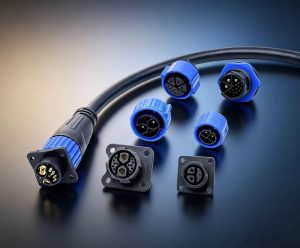
A hybrid circular connector is a connector that integrates multiple transmission functions into a single interface.
Compared with conventional connectors, it can carry not only power but also:
- Control signals
- Sensor feedback signals
- CAN Bus communication
- RS-485 communication
- Industrial Ethernet data
- Encoder signals
In short, a single connector can handle both the power supply and the communication needs of a piece of equipment.
2. How Do Hybrid Connectors Prevent Signal Interference?
Since power and data are transmitted through the same connector, preventing electromagnetic interference (EMI) is critical.
Modern hybrid circular connectors typically use the following methods:
Contact Separation
Power and signal contacts are arranged separately within the connector to reduce electromagnetic coupling and crosstalk.
Shielding Design
Metal housings, shielded cables, and 360° shielding connections help block external interference and improve EMC performance.
Differential Signaling
Protocols such as CAN Bus, EtherCAT, and Industrial Ethernet use differential signaling, which provides excellent noise immunity and reliable data transmission.
Together, these design features ensure stable communication even when power and data are transmitted simultaneously.
3. Key Advantages of Hybrid Circular Connectors
Compared with traditional solutions that require separate connectors for power, signal, and data transmission, hybrid circular connectors offer several important benefits.
Space Saving
By integrating multiple functions into a single interface, hybrid connectors help reduce installation space and support more compact equipment designs.
Simplified Wiring
Using one connector instead of multiple connectors reduces cable complexity, shortens installation time, and simplifies maintenance.
Improved Reliability
Fewer connectors and cable assemblies mean fewer potential failure points, resulting in a more reliable connection system.
Lower Overall Costs
Reduced wiring, faster assembly, and simplified maintenance can help lower both installation and operating costs.
Enhanced Environmental Protection
Many hybrid circular connectors are available with IP67, IP68, or IP69K protection ratings, making them suitable for demanding industrial and outdoor environments.
By combining power, signal, and data transmission into a single connector, hybrid solutions help manufacturers improve system efficiency while reducing complexity.
4. Typical Application Scenarios
Hybrid circular connectors are widely used in industries where both power and communication signals must be transmitted reliably.
| Industry | Typical Equipment |
|---|---|
| Industrial Automation | Servo Motors, PLCs, Encoders |
| Robotics | Collaborative Robots (Cobots), AGVs, AMRs |
| New Energy | Battery Management Systems (BMS), Energy Storage Cabinets, Charging Systems |
| Medical Equipment | Medical Imaging Systems, Diagnostic Instruments |
| Rail Transportation | On-board Control Systems |
| Outdoor Equipment | Robotic Lawn Mowers, Pool Cleaning Robots |
| Construction Machinery | Automated Construction Equipment |
These applications benefit from reduced wiring complexity, improved reliability, and space-saving designs.
5. Common Types of Hybrid Circular Connectors
Various hybrid connector sizes and configurations are available to meet different application requirements.
| Hybrid Connector Type | Key Features | Typical Applications |
|---|---|---|
| M12 Hybrid Connector | Compact Size, IP67/IP68 Protection | Sensors, Industrial Ethernet, Field Devices |
| M16 Hybrid Connector | Compact and Reliable Design | Industrial Automation Equipment |
| M23 Hybrid Connector | Combines Power, Signal and Encoder Feedback in One Interface | Servo Motors and Motion Control Systems |
| M40 Hybrid Connector | Supports High Current and Multiple Signal Circuits | Heavy Machinery and Industrial Equipment |
| Custom Hybrid Connector | Tailored Pin Layouts and Electrical Configurations | Energy Storage Systems, Robotics, New Energy Equipment |
Custom hybrid solutions are increasingly popular as equipment manufacturers seek optimized connectivity for specific applications.
Future Trends
As Industry 4.0 and smart manufacturing continue to evolve, equipment is moving toward higher integration, smaller form factors, and stronger performance.
Going forward, hybrid circular connectors are expected to deliver:
- Higher current-carrying capacity
- Faster data communication speeds
- More compact structural designs
- Improved EMC performance
These advances will allow hybrid connectors to play an increasingly important role in robotics, new energy, industrial automation, and smart equipment.
Conclusion
By integrating power, signal, and data transmission into a single interface, hybrid circular connectors achieve a high level of connection integration. Through thoughtful contact layout, shielding design, and differential transmission techniques, they can guarantee reliable power delivery while maintaining stable, dependable signal and data transmission.
For equipment manufacturers seeking high reliability, compact design, and simplified wiring, hybrid circular connectors have become an important direction for modern connection solutions. As the robotics, new energy, and industrial automation markets continue to grow, the application prospects for hybrid circular connectors will only expand further.
Q1: Can Power and Signal Contacts Be Freely Combined in a Hybrid Connector?
A: Not always. The contact layout, spacing, insulation distances, and shielding structure inside a hybrid connector are carefully designed and validated through electrical performance tests such as dielectric withstand voltage, insulation resistance, and crosstalk testing. Standard products usually have fixed pinouts. If a special contact arrangement is required, a custom design may be necessary.
Q2: Can hybrid circular connectors support Industrial Ethernet?
A: Yes. Many hybrid connectors support Industrial Ethernet protocols such as EtherCAT, Profinet, EtherNet/IP, and other high-speed communication systems.
Q3: How do hybrid connectors reduce installation costs?
A: By combining power, signal, and data transmission into one connector, they reduce the number of cables, connectors, and assembly steps required, lowering both installation and maintenance costs.
Q4: Can hybrid circular connectors be customized?
A: Yes. Custom options may include contact configurations, current ratings, cable assemblies, shielding requirements, and environmental protection levels.
Q5: What is the difference between M23 and M12 hybrid connectors?
A: M23 hybrid connectors are typically used in servo motor and motion control applications requiring higher current capacity, while M12 hybrid connectors are commonly used in compact industrial networking and sensor applications.
© Yuanyue Electronics — professional circular connector and cable assembly manufacturer
