


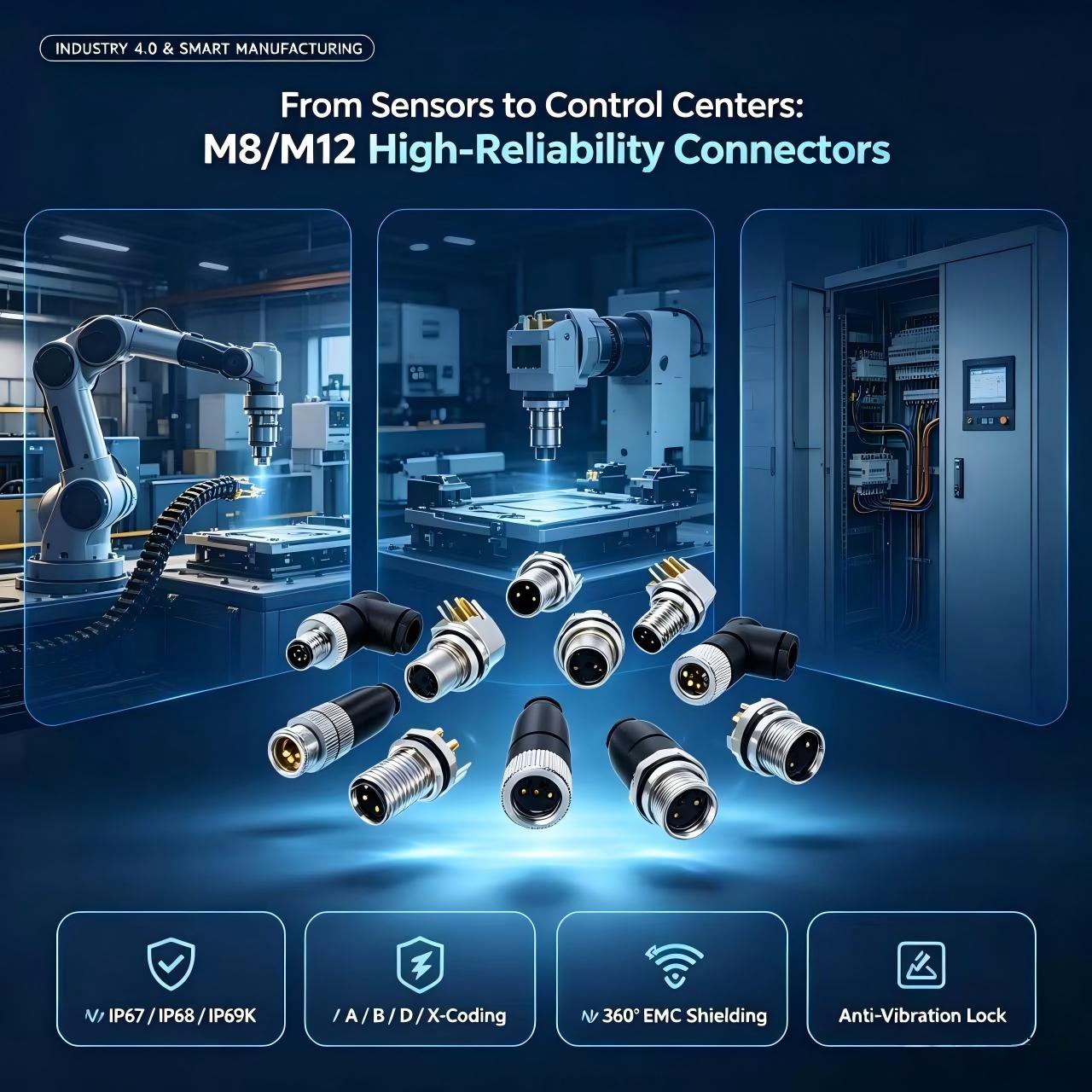
The Physical Foundation of Data Integrity
In modern smart factories, enterprises invest heavily in high-precision sensors, edge gateways, and cloud SCADA platforms. However, the physical connectivity layer remains the first line of defense for data integrity.
On actual production floors, high-frequency vibration causes micro-loosening of connector threads, moisture or oil ingress triggers short circuits, and strong electromagnetic interference (EMI) induces packet loss. A single loose connector breaks the entire data chain, directly setting the operational ceiling for Industrial IoT systems.
Data Path Topology
To ensure deterministic data flow from field sensors to high-level controllers, the physical network path is structured across four key layers:
[ Sensors / Actuators ] ──( M8/M12 Cabling )──> [ IO-Link Master / Fieldbus ] ──( M12 D/X-Code Ethernet )──> [ PLC / SCADA / Cloud ]
This continuum serves as the physical backbone of industrial automation: gathering environmental and status signals at the field level, aggregating data and bridging protocols at the distribution layer, and streaming high-speed gigabit telemetry to central control units.
Layered Connectivity Architecture & Specification Guide
Different topology nodes impose distinct mechanical, environmental, and electrical requirements on interconnect hardware:
| Network Layer | Target Applications | Recommended Connectors |
| Layer 1: Sensor & Actuator Access | Proximity switches, photoelectric sensors, pneumatic grippers | M8 (3/4-Pin) M12 A-Code (4/5-Pin) |
| Layer 2: Distributed I/O & Fieldbus | IO-Link Masters, distributed I/O blocks, valve manifolds | M12 A-Code M12 B-Code |
| Layer 3: Industrial Ethernet Uplink | Vision cameras, switch uplinks, PLC communications | M12 D-Code (4-Pin) M12 X-Code (8-Pin) |
| Layer 4: Cabinet Bulkhead & Power | Control cabinet pass-throughs, PCB-to-field, servo drives | M8/M12 Receptacles Power M12 / M23 |
Engineering Defense Against Harsh Industrial Hazards
Maintaining uninterrupted signal integrity requires specialized physical engineering features tailored to survive severe factory environments:
-
Vibration Mitigation & Mechanical Retention
Pre-compressed resilient elastomeric gaskets paired with metallic anti-vibration ratchet locking mechanisms withstand accelerations up to 20g, preventing thread backing-off under high-impact stamping operations or continuous drag-chain motion.
-
Environmental & Chemical Sealing (IP67 / IP68 / IP69K)
Precision overmolding permanently fuses the cable jacket to the connector body. This creates an impenetrable barrier resisting continuous water immersion, 80℃high-temperature 100 bar high-pressure steam washdowns (IP69K) in hygienic processing lines, and exposure to caustic cleaning chemicals.
-
Full-Path Electromagnetic Compatibility (360° EMC)
A continuous 360° metallic shield termination—from the braided cable shield to the connector housing—surrounds the signal cores, insulating weak analog signals and high-frequency digital channels from surrounding electromagnetic noise.
Physical Topology in Practical Industrial Deployments
Translating physical connectivity specifications into operational industrial environments yields specific architecture configurations:
Automotive Welding & Robotic Workstations
-
Wiring Topology: End-effector grippers (M8 Right-Angle) -Arm-mounted I/O block (M12 A-Coded)- Robot Controller Cabinet (M12 X-Coded High-Flex Drag Chain Cable).
-
Environment: Extreme flexing fatigue, weld spatter, and intense electromagnetic fields.
-
Implementation: Heavy-duty nickel-plated brass housings combined with high-flex, spatter-resistant PUR jacketed cables withstand millions of drag-chain cycles without insulation degradation or data corruption.
Machine Vision Inspection in High-Speed Production Lines
-
Wiring Topology: High-Resolution Industrial Cameras (M12 X-Coded) – Image Processing Industrial PC (M12 Panel Receptacle to RJ45).
-
Environment: Microsecond-level trigger synchronization and high-volume image file transfers.
-
Implementation: 10 Gbps X-Coded connectors featuring continuous 360° shielding minimize attenuation, ensuring lossless real-time image capture on fast-moving conveyors.
Hygienic Packaging in Food, Beverage & Pharmaceuticals
-
Wiring Topology: Bottle Inspection Sensors (M8/M12) – IP67 Fieldbus Junction Box – Control Room.
-
Environment: Daily chemical washdowns with high-pressure, high-temperature sanitizing solutions.
-
Implementation: 316L stainless steel connector housings equipped with FDA-compliant sealing rings rated to IP69K prevent fluid ingress and chemical degradation.
Comprehensive Custom Assembly Capabilities
Complex equipment integration often requires tailored interconnect engineering beyond standard catalog components:
-
Hybrid & Cross-Layer Assemblies: M12-to-M23 power/signal hybrid cables and M12-to-RJ45 cabinet transition assemblies streamline cabinet layout and reduce wiring complexity.
-
Custom Engineering & Material Matching: Support for custom cable exit angles (45°, specific 90° indexings), tailored cable lengths, and application-specific gasket materials (such as FKM fluoroelastomers for extreme oil resistance).
-
Quality Verification: All custom cable assemblies undergo 100% automated continuity, insulation resistance, and high-voltage withstand testing alongside pneumatic seal verification prior to deployment.
Summary & Technical Consultation
From field-level sensors capturing real-time physical metrics to central controllers managing enterprise operations, M8 and M12 connectors safeguard the vital signals driving modern automation. Selecting the correct interconnect configuration guarantees the physical integrity of your digital infrastructure.
Evaluating or upgrading the connectivity layer for your automated machinery?
Consult with our technical engineering team for complete system evaluation, EMC shielding optimization, or custom cable assembly design tailored to your specific application environment.
Q1: How do I choose between M8 and M12 when installation space is limited?
A: M8 is best for space-constrained micro-sensors and grippers due to its smaller footprint. M12 provides higher mechanical strength, higher pin counts, high-speed Ethernet coding, and higher power capabilities.
Q2: What is the difference between M12 D-Code and X-Code? Are they interchangeable?
A: They are not interchangeable due to distinct physical keying. D-Code is used for Fast Ethernet, while X-Code features internal cross-shielding designed for high-bandwidth Gigabit applications.
Q3: How do I select the right connectors for IO-Link architectures?
A: Use standard unshielded M8/M12 A-Code cables from field sensors to the IO-Link Master. Use fully shielded M12 D-Code or X-Code cables for the uplink from the Master to the PLC or higher-level network.
Q4: Can you provide custom hybrid or cross-layer cable assemblies for non-standard equipment interfaces?
A: Yes. Cable assemblies can be fully customized for hybrid transitions (such as M8-to-M12, M12-to-M23, or M12-to-RJ45) with options for custom exit angles, high-flex drag-chain jackets, and tailored shielding crimp methods.
