


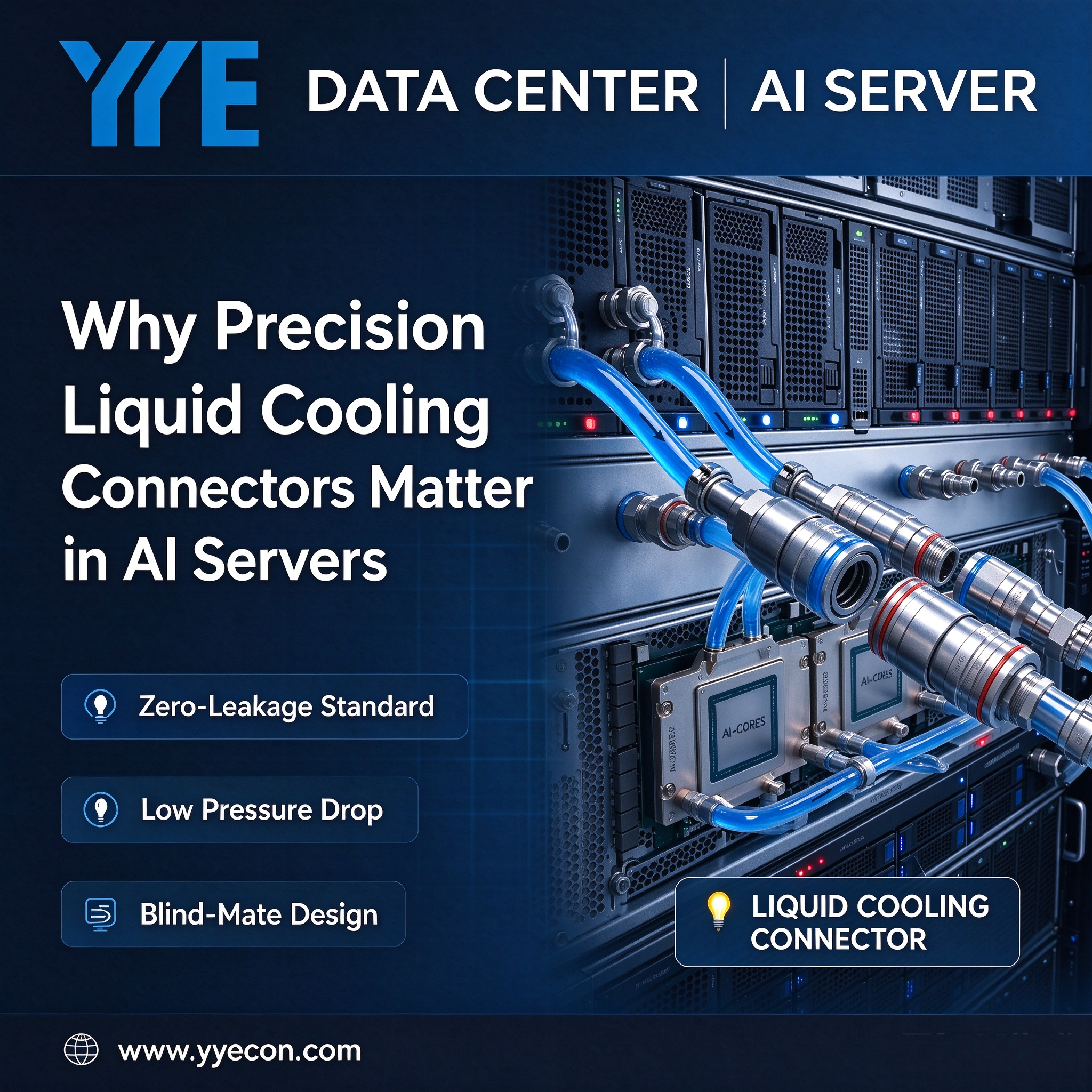
As artificial intelligence workloads scale exponentially, next-generation GPUs and AI accelerators generate unprecedented levels of heat per rack. Traditional forced-air cooling architectures have officially hit a thermal wall—air simply cannot transport heat away fast enough at these extreme power densities. To keep high-performance chips operating safely without thermal throttling, modern data centers are rapidly transitioning to liquid cooling.
However, bringing liquid directly into high-density computing environments requires specialized interconnection components. Below is an overview of why precision liquid cooling connectors are indispensable, how they function, their primary classifications, and where they are deployed in AI infrastructure.
1. Why Are Precision Liquid Cooling Connectors Needed?
Bringing fluid circuits directly into server racks introduces critical operational threats that standard plumbing fittings cannot address:
-
Zero-Leakage Protection: A single leaked drop of coolant can destroy high-value processing hardware, trigger unscheduled system downtime, and disrupt mission-critical AI compute tasks. Precision connectors ensure drip-free shutoff during maintenance.
-
Low Fluid Resistance: Cooling systems rely on pumps to circulate fluid through cold plates and pipe networks. Unrefined internal connector channels create fluid turbulence and flow resistance, forcing pumps to consume excessive energy. Hydrodynamically optimized channels lower pump workload and help maintain low Power Usage Effectiveness (PUE).
-
Thermal Stress & Expansion: During heavy AI training runs, coolant temperatures shift rapidly between supply inlets and hot return lines. Precision-machined metal housings (such as nickel-plated brass or 316L stainless steel) prevent stress concentration, ensuring seals remain secure through persistent thermal expansion and contraction.
2. What Is a Liquid Cooling Connector?
A liquid cooling connector (often referred to as a Quick Disconnect or QD) is a specialized, high-reliability fluid coupling designed to connect and disconnect coolant lines within electronic systems without fluid spillage or air inclusion.
Unlike traditional industrial hose couplings, liquid cooling connectors feature:
-
Internal Spring-Loaded Poppet Valves: Mechanically seal both sides of the fluid line the instant the coupling is separated.
-
Dual-Stage Synthetic Seals: Elastomer O-rings (typically EPDM or FKM) engineered for long-term compatibility with water-glycol mixtures or dielectric fluids.
-
Precision Locking Mechanisms: Ball-locking or latching structures that maintain constant seal engagement under continuous system operating pressure.
3. Common Types and Advantages of Liquid Cooling Connectors
To meet various operational environments, liquid cooling connectors are engineered into distinct types, each offering tailored advantages:
| Type PNG | Key Advantages & Application Features |
| Standard Blind-Mate Type | Supports large alignment offsets for easy operation, making it ideal for blind-mate board-to-board connections between server racks and CDUs. Panel-mount design enables high-density rack cabling. |
| High-Sealing Leak-Proof Type | Valved design snaps shut instantly upon disconnection to prevent any liquid dripping, protecting sensitive electronics. Supports pressure-rated hot-swapping for non-stop system maintenance. |
| High-Flow Low-Resistance Type | Designed for applications requiring high coolant flow (e.g., EV charging stations, energy storage systems). Low pressure drop reduces pump power consumption and boosts overall efficiency. |
| Multi-Channel / Hybrid Type | Simultaneously transfers cooling fluid, electrical signals, and power. Simplifies system design, reduces cable complexity, and saves space in mobile platforms like robotic arms and AGVs. |
| Lightweight Quick-Plug Type | Made primarily of engineering plastics or light metals for lightweight performance. Ideal for mobile platforms like drones and mobile robots, featuring tool-free manual plug/unplug capability. |
4. Key Application Scenarios in Data Centers & AI Servers
Precision liquid cooling connectors serve as vital fluid junctions across several critical areas within modern compute facilities:
-
Direct-to-Chip (D2C) Cold Plate Loops: Connecting the flexible fluid lines running from the rack manifold directly to the cold plates mounted on GPUs and CPUs.
-
Rack-Level Manifold Distribution: Acting as the main interface between the vertical rack manifold and individual 1U/2U server chassis in high-density EIA 19-inch and Open Rack frames.
-
Coolant Distribution Unit (CDU) Interfaces: Connecting primary facility water loops to secondary IT equipment fluid circuits, managing high-volume fluid transfer between external chillers and internal server racks.
-
Immersion Cooling Tanks: Providing sealed, quick-release fluid connections for bio-fluid or synthetic oil circulation systems in full-immersion cooling setups.
5. Summary
In an AI data center, liquid cooling connectors act as critical safety joints for the entire thermal management ecosystem. While advanced GPUs provide the raw processing horsepower, the long-term operational uptime and structural reliability of the rack depend directly on these precision mechanical components.
Contact us for expert technical assistance or to get a quick quote on liquid cooling connectors.
Q1: What is the main difference between standard QDs and UQDs in AI server cooling?
A1: Universal Quick Disconnects (UQDs) meet standardized IT specifications (like OCP) to deliver ultra-low pressure drop, cross-vendor interoperability, and guaranteed drip-free blind-mate operation in high-density AI racks.
Q2: How do liquid cooling connectors ensure zero-leakage during hot-swapping?
A2: They feature internal spring-loaded poppet valves that mechanically snap shut on both halves before the main seal opens, combined with dual-stage O-rings for complete dry-break disengagement.
Q3: Which housing materials are best for data center liquid cooling connectors?
A3: Nickel-plated brass provides optimal thermal conductivity and cost-efficiency for water-glycol loops, while 316L stainless steel offers maximum corrosion resistance and durability for high-pressure or harsh fluid environments.
Q4: How does connector pressure drop impact server efficiency and PUE?
A4: Hydrodynamically optimized connectors minimize fluid turbulence and flow resistance. This lowers coolant pump workload, reduces parasitic power draw, and helps data centers achieve a lower Power Usage Effectiveness (PUE).
Q5: Are these connectors compatible with both Direct-to-Chip (D2C) and Immersion Cooling?
A5: Yes. D2C systems typically use EPDM/FKM seals with water-glycol fluids, while Immersion Cooling requires specialized fluorocarbon seals compatible with dielectric oils to prevent swelling and degradation over time.
