


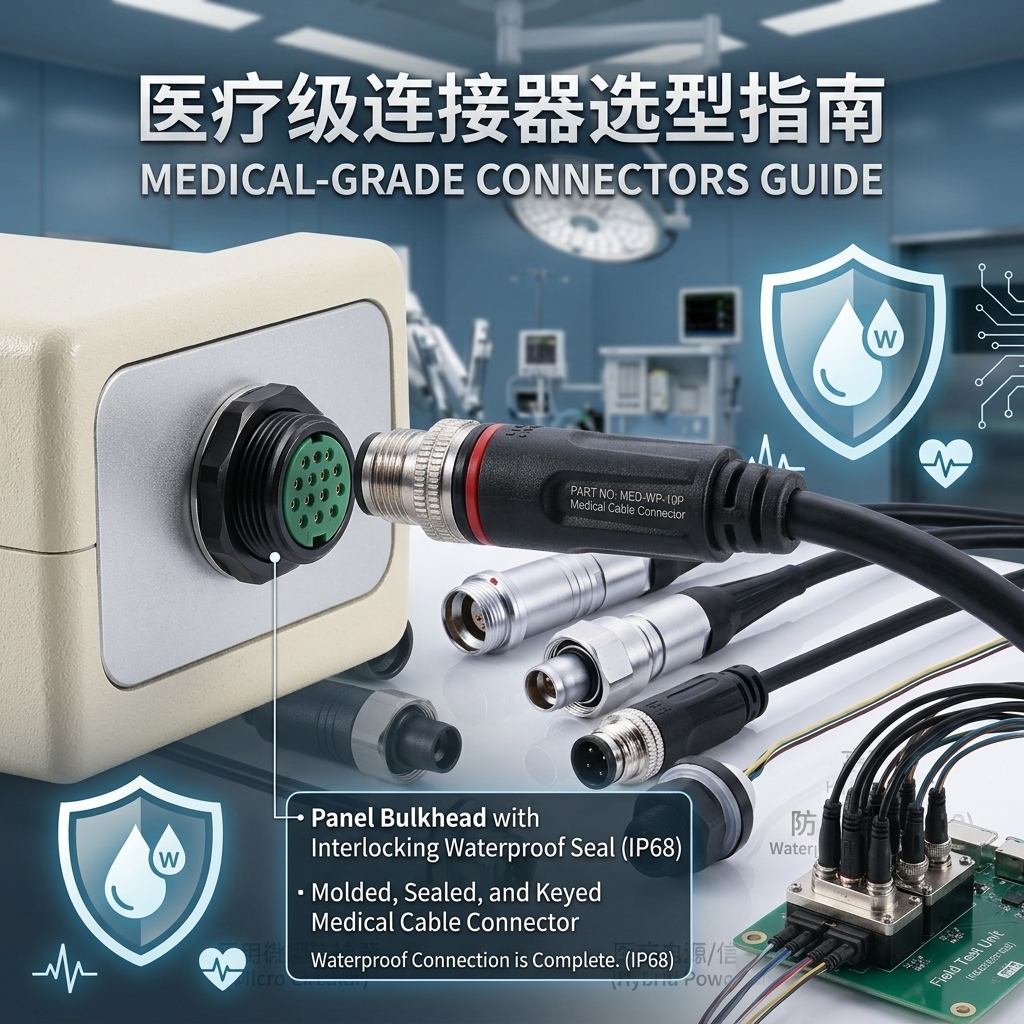
Medical-Grade Waterproof Connectors: Meeting IP68/IP69K and Chemical Disinfection Standards
In modern clinical environments—from operating rooms (OR) to intensive care units (ICU)—medical electronics must deliver uncompromising reliability. Equipment such as laparoscopic endoscopes, multi-parameter patient monitors, ultrasonic diagnostic transducers, and motorized surgical beds undergoes continuous, highly aggressive sanitation protocols to prevent hospital-acquired infections (HAIs).
For medical device original equipment manufacturers (OEMs) and design engineers, specifying the right interconnect solution is a critical factor in overall system architecture. Standard industrial-grade circular connectors routinely fail in clinical environments, causing premature material degradation, shell cracking, internal fluid ingress, signal crosstalk, and catastrophic electrical shorts.
In this comprehensive technical guide, we explore how medical-grade IP68 and IP69K waterproof connectors—along with custom overmolded cable assemblies—are engineered to withstand high-frequency chemical sterilization, rigorous mechanical handling, and strict regulatory compliance standards.
1. The Disinfection Challenge: How Harsh Chemicals Degrade Connectors
In hospital and outpatient settings, medical equipment undergoes continuous surface wipe-downs, mist spraying, and full-immersion baths in high-level disinfectants (HLD). Clinical protocols require powerful oxidizing agents and organic solvents to eradicate resistant pathogens, including spores, viruses, and bacteria. The most prevalent sterilization agents include:
75% Isopropyl Alcohol (IPA) & Ethyl Alcohol: Evaporates rapidly but continuously strips plasticizers from standard polymers.
Vaporized Hydrogen Peroxide (VHP): A powerful oxidizing agent used for room and enclosure decontamination that aggressively attacks unprotected metallic and organic materials.
Sodium Hypochlorite (Bleach Solutions): Highly effective against biological contamination, but causes rapid oxidation and severe pitting corrosion on standard metals and basic plating.
Glutaraldehyde & Peracetic Acid: Used for cold sterilization of sensitive diagnostic gear, capable of penetrating minute seams in poorly sealed connectors.
Environmental Stress Cracking (ESC)
Standard commercial thermoplastics—such as non-medical PVC, standard ABS, or untreated polycarbonates—absorb solvent molecules from these chemical agents. Over time, internal polymer chains swell and undergo molecular chain scission. When combined with the mechanical tension of cable flexing, latch engagement, or panel mounting, the housing suffers Environmental Stress Cracking (ESC). This manifests as micro-crazing on the surface, which eventually develops into complete structural fractures during routine operation.
Seal Swelling, Leaching, and Elastic Loss
Wiping and soaking directly affect internal elastomeric O-rings and gasket seals. Standard Nitrile (NBR) or Neoprene materials react with alcohol and peroxide solutions, leading to seal swelling, loss of durometer hardness, and surface tackiness. Once an elastomeric seal loses its elastic memory and compression set, liquid pathways form along the mating interface. Disinfectants then migrate into the pin cavities, corroding internal contacts, degrading insulation resistance, and triggering intermittent short circuits.
2. IP68 vs. IP69K: Choosing the Right Protection Class for Medical Gear
Selecting the appropriate Ingress Protection (IP) rating according to IEC 60529 and DIN 40050-9 standards depends entirely on how the medical device is sanitized during its operational lifecycle.
| Protection Rating | Testing Methodology & Criteria | Primary Medical Applications | Key Structural Considerations |
| IP67 | Protected against dust ingress (dust-tight) and temporary water immersion up to 1 meter for 30 minutes. | Patient monitors, ECG leadwires, diagnostic cart interfaces, and bedside infusion pumps. | Requires precision elastomeric O-rings and continuous overmolded strain relief to handle accidental spills. |
| IP68 | Complete protection against continuous submersion in liquid at specified depths (e.g., 1.5 to 3 meters for 2+ hours). | Endoscopic camera heads, submersible ultrasound transducers, and surgical tools cleaned via soaking. | Requires dual-barrier radial O-rings, hermetic pin potting (epoxy/polyurethane resin), and fluid-tight overmolding. |
| IP69K | Withstands close-range, high-pressure water jets (100 bar / 1,450 PSI) at elevated temperatures (80°C) from 4 angles. | Operating room cart systems, motorized surgical beds, and heavy automated washdown equipment. | Demands high-modulus metallic or reinforced PEEK housings, high-durometer FKM gaskets, and anti-extrusion seals. |
Engineering Considerations for IP68 Continuous Immersion
For devices such as ultrasonic transducers and video endoscopes, immersion in liquid disinfectant is a mandatory step in the reprocessing cycle. IP68 protection requires an uninterrupted fluid barrier along every joint. This is achieved by combining dual radial O-ring seals with internal resin potting around the solder or crimp terminations, ensuring that even if an outer jacket is nicked, liquid cannot travel down the internal conductors.
Engineering Considerations for IP69K High-Pressure Washdown
IP69K testing subjects the connector interface to severe thermal and mechanical shock from high-velocity water streams. High water pressure can cause softer sealing materials to deform, extrude, or unseat from their retaining grooves. Therefore, IP69K-rated medical connectors utilize high-durometer fluoroelastomers supported by rigid retaining walls to maintain a tight seal under physical impact.
3. Advanced Material Science: Medical-Grade Plastics & Elastomers
To endure thousands of rigorous sanitation cycles over a multi-year service life without physical degradation or sealing failure, medical-grade connectors rely on specialized engineering polymers and elastomeric compounds.
High-Performance Thermoplastics and Metals
PEEK (Polyether Ether Ketone): An elite semicrystalline thermoplastic offering exceptional resistance to chemical attack, organic solvents, and gamma radiation. PEEK maintains its dimensional stability and mechanical strength across repeated steam autoclave sterilization cycles at 134°C (273°F).
PPSU (Polyphenylsulfone) & PSU: Medical-grade sulfone polymers featuring extraordinary impact strength and superior resistance to Environmental Stress Cracking (ESC) caused by repeated wipe-downs with isopropyl alcohol and commercial disinfectants.
316L Surgical Stainless Steel: Used in high-end medical connectors where ultimate mechanical strength, biocompatibility, and total resistance to pitting corrosion are required.
Advanced Sealing Elastomers
Fluoroelastomers (FKM): Offer unmatched chemical inertness when exposed to harsh alcohols, synthetic disinfectants, and acidic solutions, keeping their sealing pressure over extended operational cycles.
Fluorosilicone (FVMQ): Combines the wide operating temperature flexibility of standard silicone with the chemical solvent resistance of fluorocarbons, making it ideal for devices exposed to extreme temperature variations during cleaning.
Medical Silicone (Platinum-Cured): Free of organic extractables, highly flexible, and certified for biocompatibility while resisting compression set during repeated sterilization cycles.
4. Push-Pull Quick Locking: Enhancing Ergonomics for Healthcare Staff
In fast-paced, high-stress clinical environments such as emergency rooms and surgical suites, speed, simplicity, and operational safety are paramount. Clinical personnel wearing thick latex or nitrile gloves cannot spend time aligning and threading fine-pitched screw couplings.
Key Ergonomic Benefits of Push-Pull Mating:
One-Touch Latching: The connector mates and securely locks into place with a straightforward push; it releases instantly by pulling back on the outer sliding sleeve, eliminating tedious rotation.
Tactile and Audible Feedback: A distinct physical “click” provides immediate sensory confirmation to surgical staff that a secure, fully sealed electrical connection has been established.
Zero Twist Tension on Cables: Unlike threaded connectors that twist internal cable conductors during installation, push-pull mechanisms move in a straight line, reducing internal wire fatigue and extending wire harness lifespan.
Blind-Mating & Keying Configurations: Precision mechanical keyways (such as G, A, B, or C keying) combined with color-coded connector collars prevent cross-mating when multiple cables are connected to a single diagnostic console.
5. Signal Integrity and High-Density Contacts
Modern medical systems rely on high-bandwidth data transmission alongside clean power delivery. Surgical displays require crisp 4K Ultra-HD video feeds from laparoscopic cameras, while diagnostic equipment depends on ultra-low-noise analog signals from biological sensors.
360° EMI/RFI Shielding Coverage
Surgical suites are packed with high-frequency electronic equipment, including electrocautery units, defibrillators, and nearby MRI systems. Medical connectors must incorporate a continuous 360-degree metallic shield—running from the cable braided screen directly to the connector shell—to prevent electromagnetic interference from degrading video signals or sensor readings.
Hybrid Contact Layouts in Compact Shells
Space is at a premium on portable medical devices and cart panels. Advanced medical connectors utilize hybrid contact inserts that combine high-current power contacts (for device power with high-density signal pins (for data and video within a single compact housing. This approach streamlines cable routing and simplifies device hookup for clinicians.
Precision Machined Pins with Gold Plating
To prevent contact oxidation and maintain ultra-low contact resistance across thousands of insertion cycles, contacts are precision-machined from brass or beryllium copper alloys. They receive a heavy gold plating layer over a nickel undercoat, preserving signal clarity even in low-voltage sensor circuits.
6. Regulatory Compliance & Biocompatibility (ISO 10993)
Every material used in a medical device connector that comes into direct or indirect contact with patients or clinical operators must meet strict international regulatory standards before market approval.
ISO 10993 Biological Evaluation
Connector materials must undergo rigorous testing under ISO 10993 standards to verify biological safety:
ISO 10993-5 (Cytotoxicity): Ensures materials do not release toxic substances that damage or kill biological cells.
ISO 10993-10 (Irritation and Skin Sensitization): Verifies that outer plastic shells and overmolded strain reliefs do not cause allergic reactions or skin irritation during handling.
USP Class VI Certification
Plastics and elastomeric compounds must achieve USP Class VI certification, the most stringent testing level for medical resins. This involves systemic toxicity and intracutaneous reactivity testing to guarantee zero leachables or harmful volatile compounds migrate from the connector into the clinical environment.
RoHS, REACH, and CE Compliance
Medical interconnect assemblies must comply with global environmental mandates, including RoHS 3 (Restriction of Hazardous Substances) and REACH regulations, guaranteeing that components are completely free of lead, mercury, cadmium, phthalates, and other restricted hazardous substances.
Frequently Asked Questions (FAQ)
Q1: Why can’t I use standard IP68 industrial connectors for medical devices?
Standard industrial IP68 connectors are tested primarily against clean water immersion under static factory conditions. They are not engineered to resist aggressive medical disinfectants like Isopropyl Alcohol, Vaporized Hydrogen Peroxide, or bleach solutions. Industrial plastics often suffer from Environmental Stress Cracking (ESC) when exposed to clinical cleaning agents, and their sealing materials generally lack the ISO 10993 biocompatibility certification required for medical environments.
Q2: How many mating cycles can a medical push-pull connector withstand?
High-quality medical push-pull connectors engineered with precision-machined latches and heavy gold-plated contacts typically withstand 2,000 to 5,000+ mating cycles. This high durability guarantees multi-year operational performance, even on devices connected and disconnected multiple times per day by hospital staff.
Q3: What is the difference between IP68 immersion and Autoclave sterilization compatibility?
IP68 certifies protection against liquid ingress under ambient temperatures and pressure conditions. Steam autoclaving exposes connectors to high-pressure saturated steam at 134°C (273°F) and approximately 30 PSI for extended periods. Connectors intended for autoclaving require specialized high-temperature thermoplastics (such as PEEK or PPSU) and thermally stable silicone seals to prevent melting, warping, or loss of sealing force during heating and cooling cycles.
Q4: Does YYE offer custom medical cable harnesses and overmolded assemblies?
Yes. At Dongguan Yuanyue Electronics Co., Ltd. (YYE), we specialize in manufacturing custom medical-grade circular connectors and complete overmolded cable assemblies. We offer tailored pin configurations, biocompatible cable jacketing (medical TPU, TPE, and Silicone), hybrid power/signal layouts, 360-degree shielding, and custom mold tooling designed specifically to meet your OEM engineering requirements.
Partner with YYE for Your Medical Interconnect Solutions
Designing next-generation medical devices requires interconnect components that combine total liquid resistance, chemical durability, ergonomic operation, and regulatory compliance. At Dongguan Yuanyue Electronics Co., Ltd. (YYE), we manufacture custom medical-grade connectors and overmolded cable harnesses engineered to perform in demanding clinical settings.
Need a custom waterproof interconnect solution for your upcoming medical hardware design? Contact the YYE Engineering Team today to request free product samples or submit your engineering drawings for a detailed quotation within 24 hours!
