


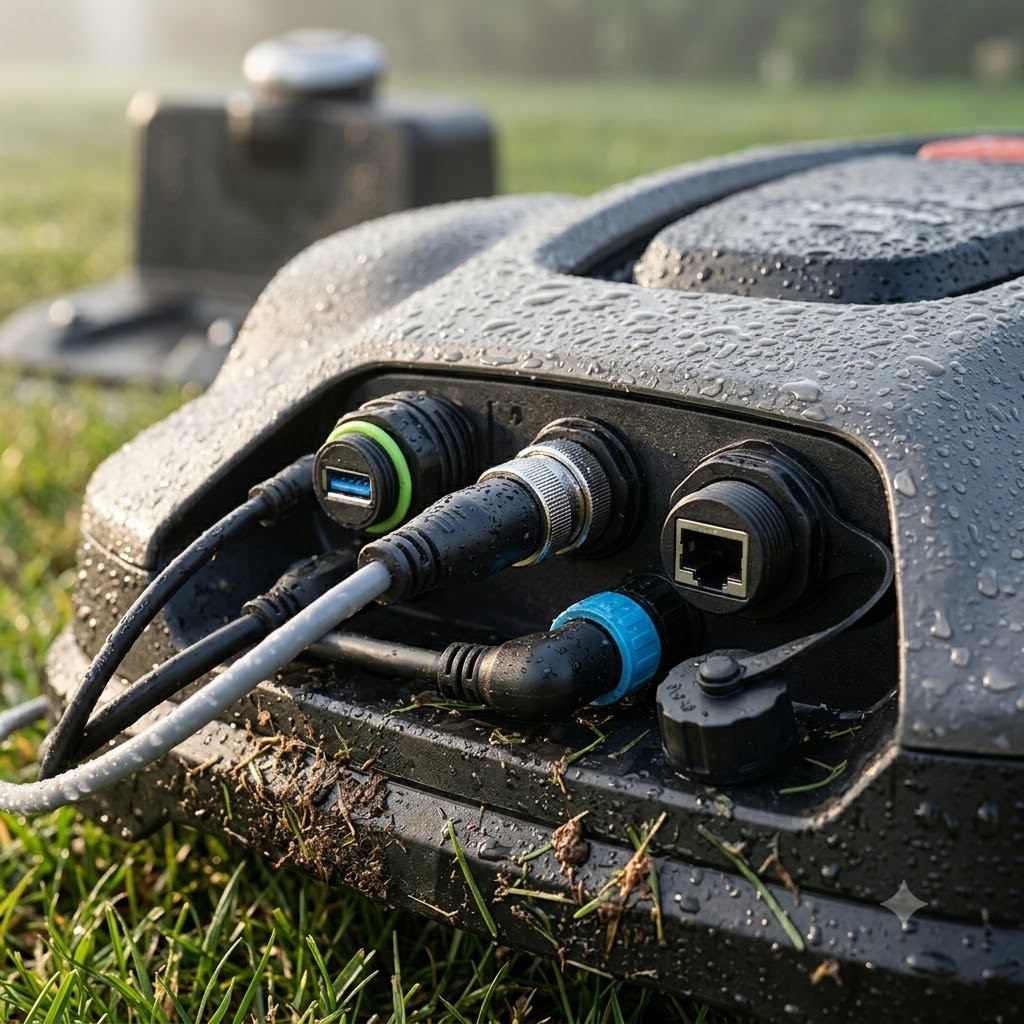
Rugged Interconnects for Smart Yard Tech: Waterproof Harness Design for Robotic Lawn Mowers
The market for smart yard equipment—particularly robotic lawn mowers, automated irrigation systems, and commercial outdoor power tools—is experiencing rapid global growth. Unlike indoor electronics, robotic mowers operate in one of the most demanding consumer environments imaginable: constant outdoor exposure, wet grass clippings, fine soil particles, UV radiation, and continuous vibration during operation.
For engineers and product designers, ensuring long-term electrical reliability hinges on one critical component: the custom waterproof cable harness and connector assembly.
In this article, we will analyze the common field failures in outdoor power equipment and explore how integrating rugged IP66/IP67 interconnect solutions can protect your products from costly field returns.
1. Environmental Challenges & Failure Analysis: Why Standard Connectors Fail
A robotic lawn mower operates autonomously for months at a time. Over its service life, standard off-the-shelf connectors quickly fail due to several severe environmental factors:
Mud, Wet Grass, and Corrosive Sap: Fine soil particles and wet grass paste accumulate around charging ports and sensor interfaces. Acidic grass sap combined with moisture accelerates corrosion of the contact pins.
Thermal Cycling & The “Breathing Effect”: Daytime solar heating raises internal temperatures, expanding the air inside the enclosure. When rain or evening dew rapidly cools the unit, a vacuum effect pulls moisture past standard O-rings and gaskets into the wiring harness.
Severe Operational Vibration: High-speed blade rotation and continuous navigation over rough, uneven terrain expose internal joints to constant shock, causing conventional threaded couplings to loosen and lose their watertight seal.
Our specialized sealed connectivity solutions are engineered to address each of these challenges specifically: they feature fully enclosed housing that blocks fine mud particles and corrosive sap from reaching contact surfaces, integrated multi-layer sealing structures that withstand the vacuum-induced “breathing effect” and prevent moisture intrusion, and integrated locking mechanisms that maintain consistent tightness even under prolonged high-intensity vibration.
For lawn mower manufacturers, this translates to dramatically reduced after-sales failure claims and extended product service life, creating clear return on investment that can be replicated across a wide range of autonomous outdoor robotic equipment across industries. Below we answer common questions about the cross-industry application and cost performance of this solution:
2. Tailored Protection: Balancing IP66 and IP67 Ratings
When specifying circular connectors and custom cable assemblies for garden automation, choosing the right Ingress Protection (IP) rating prevents both product failure and unnecessary over-engineering:
| Installation Location | Recommended Rating | Environmental Exposure | Primary Function |
| External Charging Ports & Outer Body | IP66 | High-pressure water jets, rain downpours, direct garden hose spray | Prevents water penetration during aggressive washdowns. |
| Chassis Interior, BMS & ECU Line | IP67 | Temporary water immersion, pooled water in muddy depressions | Protects vital electronics if the mower becomes submerged in wet terrain. |
By utilizing a modular protection strategy—such as quick-mating IP66 charging interfaces on the exterior paired with IP67-sealed overmolded cable harnesses inside the chassis—engineers achieve optimal field reliability while optimizing the bill of materials (BOM).
3. Protecting Unmated Charging Interfaces: Spring-Loaded Covers & Dust Caps
One of the biggest design challenges arises when a robotic mower disengages from its charging station. The exposed terminal pins immediately become susceptible to damage from dirt and moisture.
Spring-Loaded Flip Covers: Automatically snap shut over the receptacle pins the moment the robot leaves the dock, providing instant physical protection against rain, mud, and grass debris.
Tethered Waterproof Dust Caps: Ideal for manual diagnostic ports, USB maintenance slots, or firmware update interfaces, ensuring the protective cap remains attached to the chassis during servicing.
Self-Cleaning Contact Pin Design: Engineered mating contacts automatically wipe away surface oxide layers and minor dirt particles during the docking process to maintain low contact resistance.
These three connector protection designs have already been validated in mass-produced robotic lawn mower products from multiple leading brands, balancing manufacturing cost control and long-term reliability requirements.
Beyond the outdoor robotics sector, this design framework can also be adapted to similar harsh-environment connection scenarios across industries, such as charging contacts for outdoor autonomous delivery vehicles, power interfaces for agricultural IoT monitoring nodes, and waterproof connectors for construction equipment diagnostic ports, helping engineering teams reduce development iteration time while improving the overall product return on investment.
4. Material Longevity: UV Resistance and PUR & TPE Cable Jackets
Selecting a waterproof connector body is only half the battle; the cable jacket itself is frequently the first point of failure in outdoor environments.
UL 746C f1-Rated Plastics: Connectors molded from UV-stabilized PBT or Nylon materials resist yellowing, embrittlement, and cracking after thousands of hours of exposure to direct sunlight.
PUR (Polyurethane) Outer Cable Jackets: Compared to standard PVC, PUR provides exceptional resistance to abrasion from thick grass, damage from exposure to petroleum and oils, and degradation from chemical lawn treatments. It also retains high flexibility across an extreme temperature range of (-30°C to +80°C.
TPE (Thermoplastic Elastomer) Outer Cable Jackets: As another high-performance alternative to general PVC, TPE balances cost-effectiveness with strong environmental resistance, delivering good low-temperature flexibility and UV stability for moderately demanding outdoor applications. For applications that require direct soil burial or long-term submersion, additional jacket-rating certifications, such as IP68, can ensure the entire cable assembly maintains insulation and performance even under constant moisture exposure.
Matching the right jacket material to your specific outdoor exposure conditions directly extends the service life of the entire connection system, reducing long-term maintenance costs and unplanned downtime.
5. Mating Mechanisms: Quick-Locking and Overmolded Strain Reliefs
Robotic mowers require quick assembly during manufacturing, effortless servicing by technicians, and consistently stable connection while in motion.
Bayonet and Push-Pull Locking: Replacing traditional threaded couplings with bayonet (1/4-turn) or push-pull self-locking mechanisms enables “one-touch” mating. These interfaces eliminate the risk of cross-threading and cannot vibrate loose during operation.
Low-Pressure Overmolding: Overmolding the cable-to-connector transition encapsulates internal solder or crimp joints in solid resin. This provides integrated strain relief and forms a 100% water-tight barrier that prevents internal moisture ingress.
Compact Design: Smaller, lighter connector designs fit seamlessly into the limited internal space of robotic mowers, without adding unnecessary bulk that would interfere with the mower’s navigation or cutting mechanisms. This also helps manufacturers keep the overall unit weight optimized for battery-powered operation, extending runtime on a single charge.
Corrosion Resistance: Using high-grade engineered plastics and plated contact materials ensures connectors withstand long-term exposure to grass clippings, fertilizer, rain, and temperature fluctuations common in outdoor lawn environments. This reduces long-term failure rates, cuts maintenance costs for both manufacturers and end users, and delivers a higher return on investment across the product lifecycle.
Beyond robotic lawn care, these same connector design benefits translate to other outdoor autonomous equipment, agricultural sensors, and industrial robotics, demonstrating cross-industry versatility that improves product reliability and lowers total system cost.
6. Cross-Industry Applicability & ROI
The ruggedized interconnect design principles developed for robotic lawn mowers translate directly across the broader AgTech and Smart Yard ecosystems:
Smart Irrigation Controllers & Solenoid Valves require subterranean IP68 seals against mud and groundwater.
Commercial Outdoor Power Equipment (OPE): Handheld battery trimmers and blowers need rugged, high-current quick-disconnect interfaces.
Perimeter Wire Transmitters: Outer docking hubs are exposed year-round to soil moisture and fertilizer chemicals.
The ROI of Quality Interconnects: Investing in application-specific waterproof harnesses increases initial BOM costs marginally, but yields massive savings by dramatically reducing warranty claims, field service calls, and damage to brand reputation.
Frequently Asked Questions (FAQ)
Q1: What is the difference between IP66, IP67, and IP68 for outdoor robotic equipment?
IP66 protects against high-pressure water jets from any direction, such as exposure to garden hoses or heavy rain. IP67 guarantees protection against temporary water immersion up to 1 meter depth for 30 minutes. IP68 is designed for continuous, long-term underwater submersion under specified depth and pressure conditions. Most robotic mower exteriors require IP66, while internal electronics and drive motors benefit from IP67/IP68 protection.
Q2: Why does water still get inside my equipment even when using an IP67-rated connector?
Water ingress often occurs due to the “cable wicking effect” (capillary action) or thermal cycling. If a cable jacket is nicked, or the connector seal fails slightly, temperature drops create internal negative pressure that sucks moisture along the stranded copper wire inside the harness. Using overmolded strain reliefs and potted wire blocking prevents this issue.
Q3: How do UV-stabilized plastics (UL 746C f1) protect outdoor cable harnesses?
Standard plastics lose plasticizers when exposed to ultraviolet (UV) radiation from sunlight, becoming brittle and developing micro-cracks over time. Plastics certified under UL 746C f1 have passed rigorous accelerated UV exposure and water immersion testing, ensuring long-term structural and sealing integrity for outdoor use.
Q4: Can YYE customize connector pinouts and overmolded cable assemblies for specialized mower designs?
Yes, we specialize in custom circular connectors and overmolded cable assemblies. We offer tailored pin configurations, hybrid power/signal layouts, custom cable lengths, and custom mold tooling to meet your exact design specifications.
Partnering with YYE for Custom Outdoor Cable Assemblies
Designing a reliable robotic lawn mower or outdoor power tool requires more than just off-the-shelf components. At Dongguan City Yuanyue Electronics Co., Ltd. (YYE), we specialize in custom waterproof circular connectors, overmolded cable harnesses, and tailored interconnect solutions.
Whether you need UV-resistant IP67 overmolded harnesses, custom pinout configurations, or spring-cap charging interfaces, our engineering team provides rapid prototyping and rigorous environmental testing (salt spray, IPX6/IPX7 immersion, and pull-force testing) to ensure your product thrives in outdoor environments.
Planning your next-generation outdoor hardware project?
Contact the YYE Engineering Team today to request free product samples, or submit your custom harness drawings for a 24-hour quotation!
