


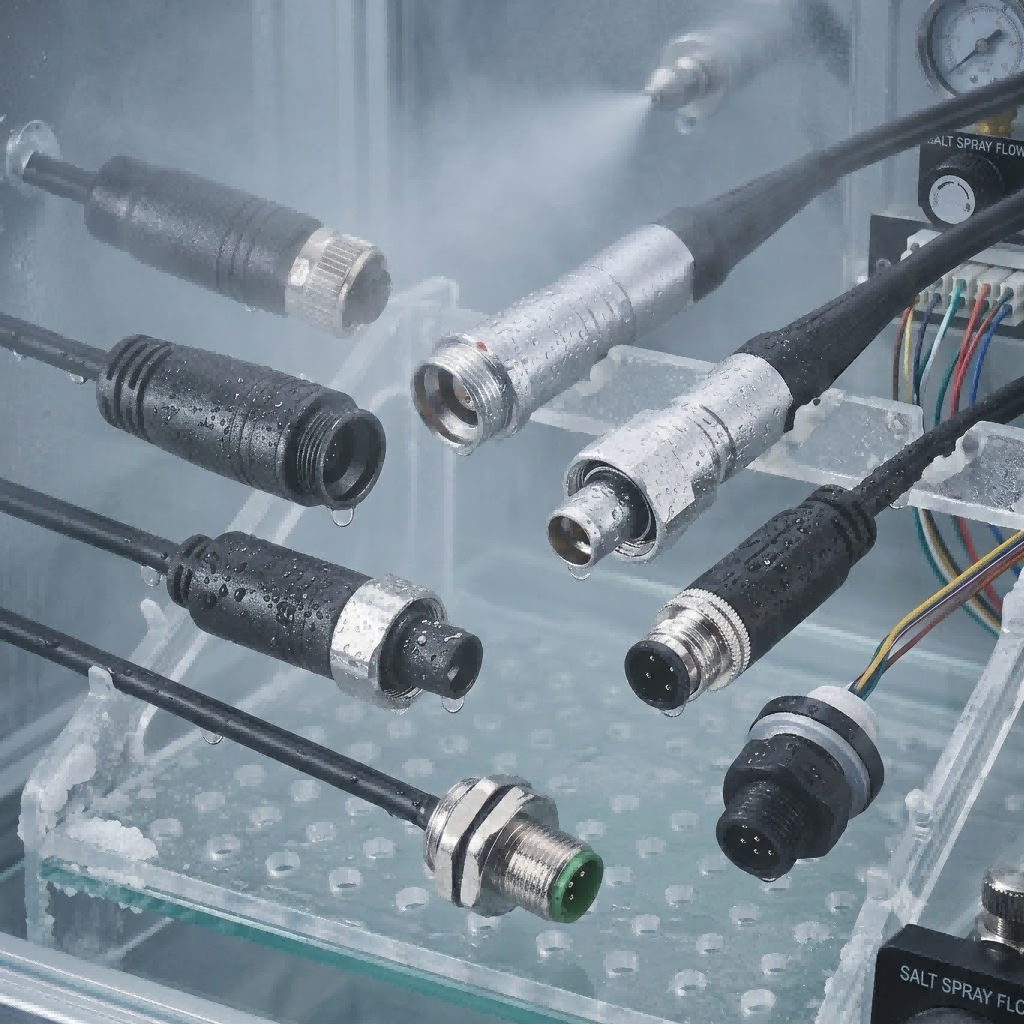
What Does Salt Spray Testing Really Mean for Marine-Grade Circular Waterproof Connectors?
When deploying electronic systems in maritime environments—whether for offshore wind turbines, commercial shipping, port automation, or underwater ROVs—nature is your biggest adversary. Among all environmental hazards, the combination of high humidity and airborne salt is the ultimate “silent killer” of connectivity.
As an engineer or procurement manager sourcing components, you will frequently encounter terms like “Salt Spray Tested” or “ASTM B117 Compliant” on component datasheets. But what do these ratings actually mean for your project’s service life? And how can you distinguish a truly marine-grade circular connector from a standard industrial one?
Let’s dive into the core technicalities of salt spray testing and explore why it is the foundation of reliable marine connectivity.
1. The Marine Environment: A Catalyst for Electrochemical Destruction
Ocean air is heavily saturated with chloride ions, which are highly corrosive and accelerate metal oxidation. However, the primary threat to circular connectors is galvanic corrosion (also known as electrochemical corrosion).
When a connector is energized, the presence of salt water or salt mist acts as a highly conductive electrolyte. If two dissimilar metals inside the connector—for example, an aluminum shell and a brass retaining nut—come into contact in this environment, an electric current will flow between them. This causes the less noble metal to corrode at an alarming rate.
What are the consequences? A dramatic increase in contact resistance, signal degradation, intermittent power outages, or even catastrophic short circuits. In marine operations, a failed connector does not just cause downtime—it requires dispatching a specialized maintenance vessel to sea, which costs thousands of dollars per hour.
2. Deciphering the Test: NSS vs. Hours of Resistance
To ensure components can withstand this onslaught, manufacturers subject connectors to accelerated aging laboratory tests, most commonly guided by international standards such as ASTM B117, ISO 9227, or IEC 60068-2-11.
Inside a salt spray chamber, connectors are exposed to a continuous, atomized fog of a sodium chloride solution at a controlled temperature.
When evaluating datasheets, pay close attention to the testing duration:
– Standard Industrial Grade (48 to 96 Hours): Suitable for indoor factories or sheltered outdoor environments with minimal chemical exposure.
– Marine-Grade (500 to 1,000+ Hours): This is the threshold for true maritime applications. A connector rated for 1,000 hours of Neutral Salt Spray (NSS) demonstrates exceptional plating integrity and material resilience.
A Quick Reality Check for Buyers: 1,000 hours in a test chamber does not perfectly translate to exactly 1,000 hours of service in the real ocean. The salt spray test is an accelerated benchmark used to verify manufacturing quality, plating thickness, and material uniformity.
3. The Anatomy of a 1,000-Hour Marine Connector
Achieving a 1,000+ hour salt spray rating requires meticulous engineering across every component. Here is how marine-grade design compares to standard industrial alternatives:
| Component | Standard Industrial Grade (48–96 Hours) | Marine-Grade Excellence (500–1,000+ Hours) | Why It Matters for Maritime Systems |
| Shell Material & Surface Treatment | Standard Aluminum, basic zinc plating, or thin anodizing. | 316L Stainless Steel, marine bronze, or high-density Aluminum with heavy Nickel/Chrome plating. | Prevents pitting, crevice corrosion, and structural degradation from constant salt mist exposure. |
| Contact Pins & Plating | Brass or bronze with flash Gold plating or Tin plating. | Premium copper alloys with heavy Gold plating over a dense nickel undercoat. | Gold is a noble metal that resists oxidation, maintaining stable, ultra-low contact |
| Elastomer Seals & O-Rings | Standard Nitrile Rubber (NBR) or low-grade plastics. | High-performance Viton (Fluorocarbon) or premium marine-grade Silicone. | Retains elasticity and compression under prolonged UV and salt exposure, preventing seals from cracking and leaking. |
4. The Checklist: How is a Salt Spray Test “Passed”?
When reviewing a supplier’s laboratory test report, a simple “Pass” is not enough. A rigorous compliance evaluation inspects three metrics:
Visual Inspection: The shell must show zero signs of “red rust” (base metal corrosion) or significant “white rust” (plating degradation). The coating must not blister, crack, or peel.
Electrical Integrity (The Most Critical): Engineers must measure Contact Resistance before and after the test. The variance should be negligible (within a few milliohms). Furthermore, Insulation Resistance must remain high to prove no salt water has breached the core.
Mechanical Functionality: Can the connector still mate and unmate smoothly? The locking mechanism (whether it is a screw thread, bayonet, or push-pull system) must not be seized or jammed by corrosive byproducts.
5. Engineering Guide: How to Choose the Right Connector for Your Marine Application
Not all marine connector applications are created equal. To avoid over-engineering or premature failure, carefully consider the exact installation location of your connector:
Zone 1: Deep Submersion & Splash Zones (Most Severe Conditions)
Application: Underwater ROVs, subsea sensors, and deck machinery that are constantly exposed to seawater.
The Choice: Specify 316L Stainless Steel shells, a minimum of 30u” Gold-plated contacts, and a verified 1,000-hour Salt Spray rating. Ensure the connector holds an IP68 or IP69K rating with Viton seals to withstand both corrosion and high-pressure washdowns.
Zone 2: Topside & Exposed Outdoor Decks
Application: Marine radar, GPS antennas, solar array trackers on ships, and offshore wind towers.
The Choice: High-grade Aluminum alloys with thick marine-grade anodizing, or composite plastics (PBT with UV inhibitors), deliver an excellent lightweight, cost-effective solution. Look for a 500 to 720-hour Salt Spray rating and IP67/IP68 ingress protection.
Zone 3: Interior Cabins & Sheltered Electronics
Application: Control panels, bridge navigation displays, and indoor communication racks.
The Choice: Although these connectors are protected from direct spray, the surrounding air remains highly humid and salty. A standard brass or copper alloy connector with nickel/gold plating (48 to 96-hour Salt Spray rating) is typically sufficient, cutting project costs without compromising reliability.
6. Frequently Asked Questions (FAQ)
Q1: Does a 1,000-hour salt spray rating mean the connector will last exactly 1,000 hours in real ocean conditions?
A: No. The salt spray test (such as ASTM B117) is an accelerated laboratory test designed to evaluate the uniformity and corrosion resistance of coatings and materials under extreme, continuous salt mist. Real-world marine environments are dynamic, involving shifting tidal cycles, UV exposure, and temperature fluctuations. A 1,000-hour rating is an industry benchmark indicating that the connector has the high plating density and material integrity required for years of reliable long-term service in outdoor marine settings.
Q2: What is the difference between NSS, AASS, and CASS salt spray tests?
A: These tests differ in the chemical composition of the test solution used inside the chamber:
NSS (Neutral Salt Spray): The most common standard, which uses a neutral salt solution (with a pH of 6.5–7.2. It is widely applied to testing steel, zinc, and copper alloys.
AASS (Acetic Acid Salt Spray): Adds acetic acid to the salt solution (to achieve a pH of 3.1–3.3, simulating more aggressive industrial and marine atmospheres.
CASS (Copper-Accelerated Acetic Acid Salt Spray): Adds copper chloride to the acetic acid salt solution to further accelerate the corrosion process. It is commonly used for testing high-performance decorative or engineering platings (such as heavy chrome or nickel on plastics or aluminum).
Q3: Why is gold plating preferred over tin or silver plating for marine connector contacts?
A: Silver is highly conductive but tarnishes rapidly when exposed to sulfur and chlorides in ocean air, forming a non-conductive layer. Tin is prone to fretting corrosion and oxide film buildup. Gold (Au) is a noble metal that does not oxidize or react with salt mist. Maintaining a proper gold plating thickness (e.g., 15u” or 30u”) ensures that contact resistance remains ultra-low and stable over hundreds of mating cycles in salty, humid conditions.
Q4: Can I use an aluminum-shell circular connector on a boat, or must it be stainless steel?
A: You can use aluminum, but only if it has proper marine-grade surface treatment, such as specialized anodizing or heavy nickel-chrome plating that can withstand a 500+ hour salt spray test. High-grade aluminum alloys deliver an excellent lightweight, cost-effective solution for topside, sheltered, or cabin electronics. However, for splash zones, deck machinery, or subsea applications directly exposed to constant seawater, 316L stainless steel is strongly recommended due to its superior resistance to pitting and crevice corrosion.
Conclusion: Don’t Compromise on Sea-Bound Systems
In marine electronics, cutting corners on connector quality is a ticking time bomb. Choosing a circular waterproof connector backed by a certified 500- or 1,000-hour salt spray test is an investment in system longevity, operational safety, and brand reputation.
Are you looking for reliable connectivity for your next marine project? Contact our team today to request physical samples, or discuss a customized waterproof cable assembly tailored to your specific application.
