


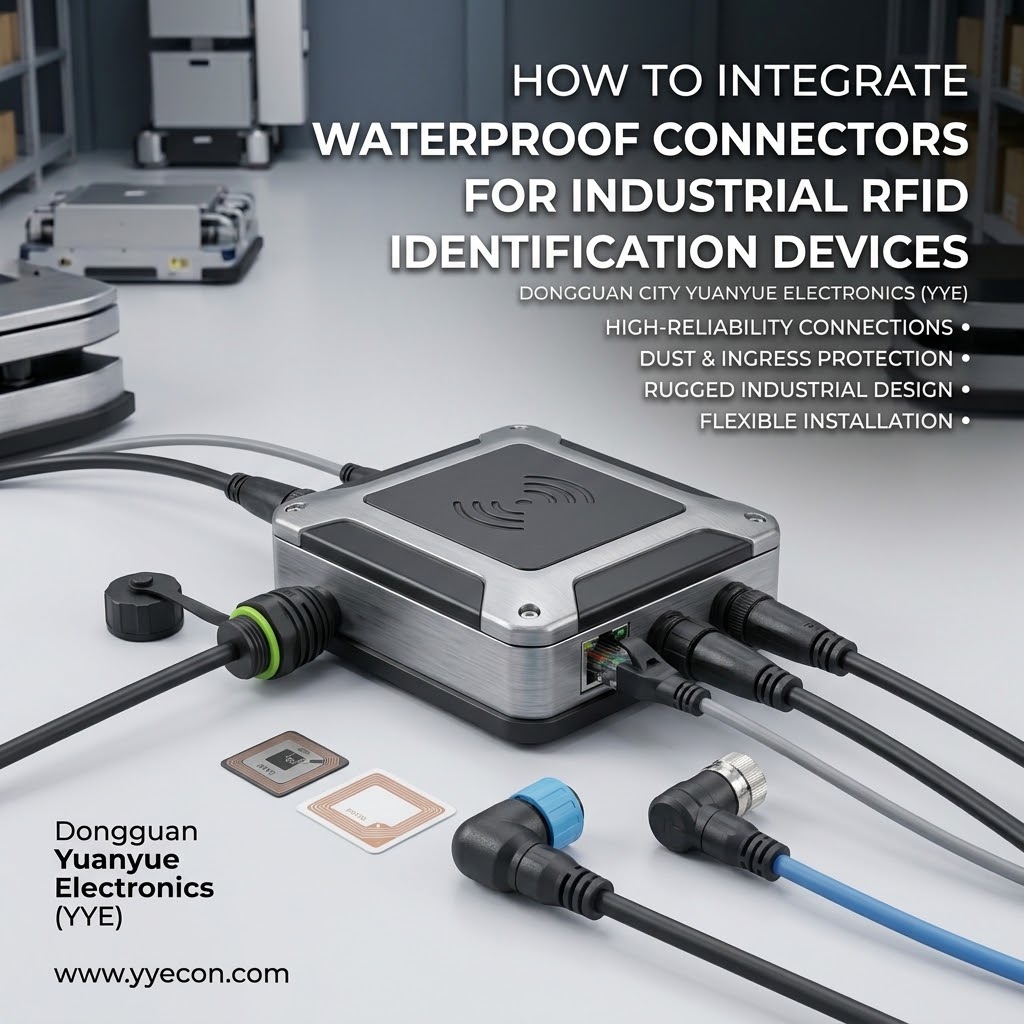
Waterproof Cable Solutions for RFID Readers in Smart Manufacturing and Logistics Automation
In modern Industry 4.0 environments, Radio-Frequency Identification (RFID) technology serves as the backbone of real-time asset tracking, automated material handling, and smart supply chain management. While high-performance RFID readers and antennas often receive the most attention, the reliability of the entire identification infrastructure frequently depends on a less visible component: the physical cable assembly. In harsh manufacturing and logistics settings, moisture, chemicals, oil exposure, and mechanical stress constantly threaten signal integrity and operational uptime. Implementing rugged, waterproof cable solutions tailored for industrial RFID systems is not merely an option—it is a baseline requirement for uninterrupted automation.
1. Harsh Operating Environments in Smart Logistics & Manufacturing
Smart manufacturing plants and automated logistics hubs subject equipment to a demanding mix of physical and environmental stressors. Industrial RFID readers deployed on conveyor lines, automated guided vehicles (AGVs), sorting systems, and outdoor loading docks are exposed to wet and dirty conditions daily.
Moisture & Washdown Conditions: In food, beverage, and pharmaceutical facilities, machinery undergoes frequent high-pressure washdowns with caustic detergents, requiring IP67, IP68, or IP69K ingress protection.
Chemical & Oil Exposure: Automotive assembly lines and metalworking shops expose cables to synthetic coolants, cutting fluids, and lubricating oils, which can degrade standard PVC cable jackets.
Thermal Extremes & Condensation: Cold-storage warehouses and outdoor tracking gantries experience drastic temperature fluctuations, leading to moisture condensation inside non-sealed connectors.
2. Key Technical Requirements for Industrial RFID Waterproof Cable Assemblies
Selecting the right cable assembly requires a thorough understanding of the structural materials and shielding mechanisms necessary to protect critical RFID signals.
Overmolded TPU/PUR Jackets: Thermoplastic Polyurethane (TPU) and Polyurethane (PUR) offer outstanding resistance to abrasion, tear, oil, and hydrolysis compared to standard PVC. Overmolded strain reliefs ensure that water cannot penetrate the backshell.
High-Fidelity EMI/RFI Shielding: High-frequency RFID data transmission is vulnerable to electromagnetic interference from nearby motors, high-voltage lines, and variable frequency drives (VFDs). Double-shielded configurations (tinned copper braid plus aluminum foil) maintain high signal-to-noise ratios.
Dynamic Drag-Chain Durability: RFID readers mounted on robotic arms or linear gantries require high-flex cables rated for millions of bending cycles without conductor fatigue.
3. M12 and M8 Circular Connectors: The Standard for RFID Connectivity
Circular connectors have long established themselves as the industry standard for industrial sensor and identification networks, offering compact footprints and mechanical stability.
| Connector Type | Coding & Pins | Primary RFID Application | Ingress & Locking Features |
| M12 A-Coded | 4, 5, 8 or 12 Pins | Power supply and standard DC discrete I/O for readers | IP67/IP68 threaded coupling, vibration-proof ratchet mechanism |
| M12 D / X-Coded | 4-Pin (D) / 8-Pin (X) | Industrial Ethernet (PROFINET, EtherNet/IP) RFID readers | High-speed data shield separation, IP67 overmolded design |
| M8 Connector | 3, 4, or 6 Pins | Compact RFID heads and space-constrained sensors | Snap-in or threaded locking, ideal for light industrial automation |
4. Real-World Application Scenarios: Where Waterproof RFID Cables Make the Difference
Robust cable assemblies prove their value across diverse industrial domains:
Automated Guided Vehicles (AGVs) & AMRs: Mobile robots navigating warehouse floors require flexible, oil-resistant M12 cable harnesses to transmit reader data under continuous movement and vibration.
Food & Beverage Processing Lines: High-pressure washdown environments rely on IP69K-rated stainless steel M12 connectors with FKM/Silicone seals to prevent moisture ingress and bacteriological contamination.
Outdoor Yard Management & Cold Chains: Ruggedized antenna feeder cables withstand UV degradation and sub-zero temperatures while maintaining stable RF impedance for long-range asset tracking.
5. Preventing Signal Loss & RF Attenuation in Long-Distance Waterproof RFID Cabling
In large-scale logistics automation, RFID readers and antennas are often located several meters away from the central PLC or control cabinet. Standard cable assemblies can experience significant high-frequency (HF) and ultra-high-frequency (UHF) RF attenuation (signal loss) over distance. Moisture penetration—even at a microscopic level—drastically alters cable impedance (typically 50 ohms for RF lines), causing signal reflections, reduced read ranges, and packet loss.
To eliminate signal loss in extended runs, waterproof RFID cabling must employ an ultra-low-loss coaxial design with physically foamed PE dielectric cores, precision-controlled characteristic impedance, and gas-tight overmolded connector interfaces. Ensuring complete moisture resistance protects the electrical dielectric constant over years of continuous operation, maintaining maximum read speeds and identification accuracy across expansive warehouse facilities.
6. Custom Cable Harness vs. Off-the-Shelf Options for RFID Systems
While off-the-shelf patch cords are readily available, specialized industrial automation projects often require custom wire harness engineering. Standard cables frequently lack precise length optimization (leading to cable clutter or strain), custom pinout assignments for hybrid power-and-data lines, or specialized outer jacket materials tailored to specific chemical exposures. Partnering with an experienced custom harness manufacturer ensures optimal overmolding quality, 100% electrical testing, certified IP ratings, and reduced long-term maintenance costs.
Tailored cable assemblies also shorten on-site installation time by eliminating on-site cutting, stripping, and connector crimping work, enabling engineering teams to speed up project commissioning and put automated logistics facilities into operation earlier. For long-term system upgrades and retrofits, pre-designed custom harnesses also make part replacement and system expansion more convenient, helping enterprises maintain stable operation of automated logistics systems throughout their entire lifecycle.
Frequently Asked Questions (FAQ)
Q1: What is the difference between IP67, IP68, and IP69K ratings for RFID cables?
Answer: IP67 protects against temporary immersion in water up to 1 meter for 30 minutes. IP68 offers protection against continuous submersion under specified pressure and time conditions. IP69K is the highest rating, designed specifically to withstand high-pressure, high-temperature washdown procedures (up to 80°C and 100 bar) common in food and beverage plants.
Q2: Why is TPU preferred over PVC for industrial RFID reader cables?
Answer: TPU (Thermoplastic Polyurethane) provides far superior mechanical strength, abrasion resistance, and flexibility compared to PVC. It is highly resistant to industrial oils, coolants, microbial attack, and UV radiation, making it the preferred choice for drag-chain applications and harsh factory environments.
Q3: How does improper cable shielding affect industrial RFID performance?
Answer: Inadequate shielding allows Electromagnetic Interference (EMI) from nearby motors, VFDs, and power lines to distort RF signals or digital bus communication. This leads to misread tags, dropped connections, reduced read ranges, and delayed data reporting in automated sorting systems.
Q4: Can custom M12 RFID cable assemblies integrate both power and data?
Answer: Yes, hybrid custom cable assemblies can combine shielded data pairs and larger-gauge power conductors within a single overmolded cable. This reduces wiring complexity, saves installation space, and simplifies maintenance on automated machinery and AGV platforms.
Conclusion
In the era of smart manufacturing and logistics automation, industrial RFID readers are essential for maintaining continuous visibility across supply chains and production lines. However, the operational reliability of these identification systems depends heavily on the quality of their interconnects. Standard commercial cables often fail when exposed to moisture, industrial oils, mechanical strain, and severe electromagnetic interference (EMI).
By integrating rugged waterproof cable solutions—featuring overmolded TPU/PUR jackets, robust IP67/IP68/IP69K sealing, high-density EMI shielding, and M8/M12 circular connectors—engineers can eliminate signal attenuation, prevent ingress failure, and avoid costly production downtime.
As a professional custom wire harness manufacturer, Dongguan Yuanyue Electronics Co., Ltd. provides engineered waterproof cable assemblies tailored to your specific RFID reader and antenna requirements. Whether you need high-flex drag-chain cables for AGVs or IP69K-rated connectors for food processing lines, our OEM/ODM custom harness solutions deliver maximum transmission accuracy and long-term durability. Contact our engineering team today to discuss your industrial RFID cabling needs or request custom product samples.
