


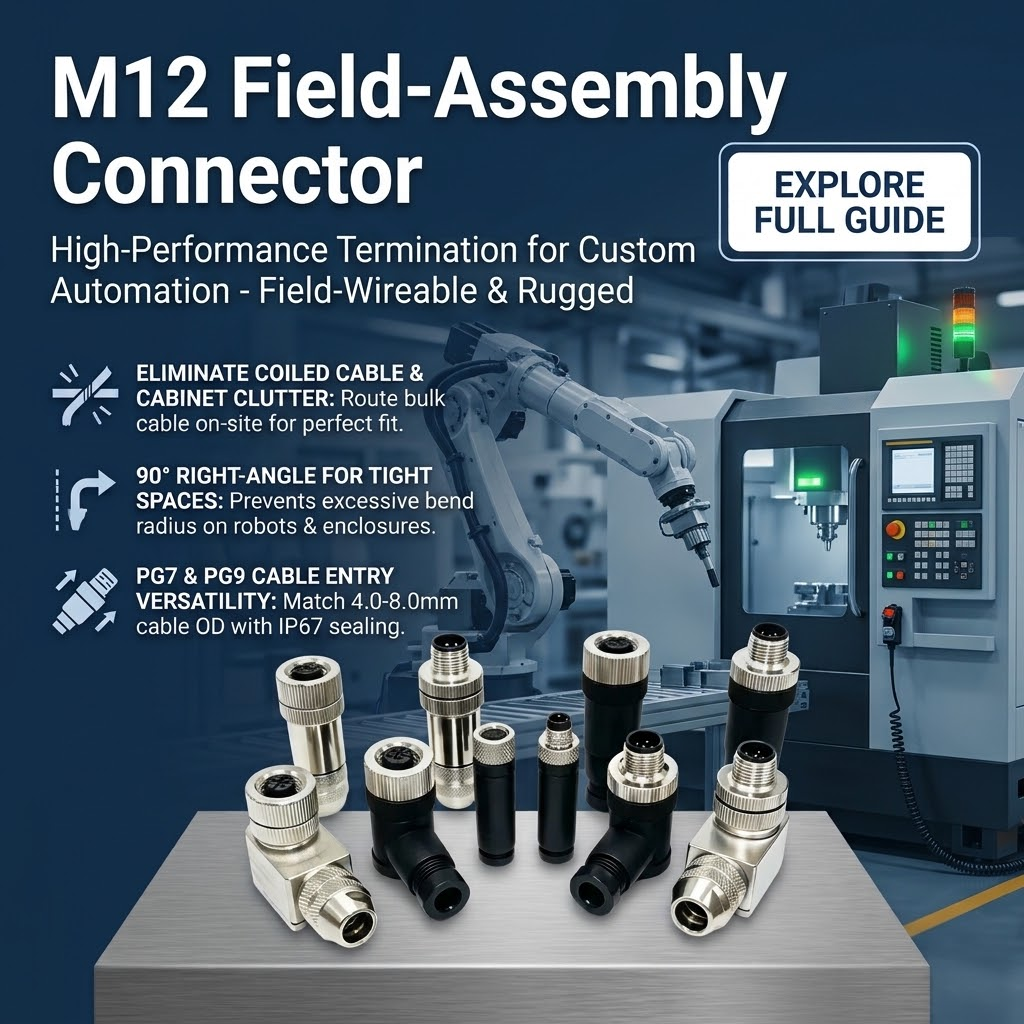
In the fast-paced world of industrial automation, custom machinery and bespoke production lines require maximum layout flexibility. While pre-molded cable assemblies are widely used in standard factory setups, system integrators and automation engineers frequently encounter physical constraints on the shop floor where rigid, pre-determined cable lengths fall short.
This is where M12 field-assembly (field-wireable) connectors—available in both metal and plastic housings, straight and 90° right-angle configurations, and PG7/PG9 cable gland options—become indispensable.
1. The Real-World Pain Points of Pre-Molded Cable Assemblies
When building non-standard, custom automated equipment, engineering teams face unique installation challenges:
-
Inflexible Cable Lengths & Cable Clutter: Pre-molded cables come in fixed lengths (e.g., 2m, 5m, 10m). Excess cable must be coiled and stuffed into tight control cabinets, creating visual clutter, restricting airflow, and increasing electromagnetic interference (EMI) risks.
-
Routing Through Tight Conduits & Drag Chains: Threading a thick, pre-molded M12 connector head through narrow cable glands, conduits, or dense drag chains is often physically impossible without damaging the connector or cable jacket.
-
Unpredictable On-Site Dimensions: In custom automation, final sensor-to-cabinet distances are rarely finalized until full mechanical assembly. Ordering exact cable lengths beforehand frequently leads to costly delays and rework.
2. Why M12 Field-Assembly Connectors Are the Ultimate Solution
Field-wireable M12 connectors allow technicians to cut cables to the exact required length on-site and terminate them directly at the connection point. Here is why they are essential for custom automation:
A. Cable Entry Versatility: PG7 vs. PG9 Options
Matching the connector’s rear cable gland size with the outer diameter (OD) of the raw cable is critical for maintaining IP67 ingress sealing:
-
PG7 Cable Gland (Cable OD Range: 4.0mm – 6.0mm): Ideal for standard 3-pin, 4-pin, and 5-pin M12 A-Code sensor/actuator cables, such as proximity sensors, photoelectric switches, and low-power DC control signals.
-
PG9 Cable Gland (Cable OD Range: 6.0mm – 8.0mm): Designed for thicker multi-core cables, high-density 8-pin/12-pin signal wires, shielded D-Code/X-Code industrial Ethernet cables (PROFINET/EtherCAT), or higher-current M12 power lines.
B. Versatile Housing Options: Metal vs. Plastic
Custom automation systems operate across diverse environmental conditions. M12 field-assembly series cater to these distinct needs:
-
Full Metal Shielded Connectors: Precision-machined with nickel-plated brass or stainless steel, these provide 360° EMC shielding and high mechanical durability for high-noise CNC machinery, heavy vibration zones, or robotic joints.
-
High-Grade Plastic Connectors: Lightweight and cost-effective, plastic M12 connectors offer strong insulation and IP67 protection for general-purpose sensors, IO-Link modules, and light-duty conveyors.
C. Straight and 90° Right-Angle Form Factors
Spatial restrictions are a constant headache in custom machinery.
-
Straight Connectors: Ideal for open-access sensor panels and linear cable runs.
-
90° Right-Angle Connectors: Essential for compact machine enclosures, robotic arms, or wall-mounted proximity switches where tight bend radii could strain or break raw wire leads.
3. Key Benefits for Automation System Integrators
-
Reduced Inventory Costs: Instead of stocking dozens of pre-molded cable length variations, integrators only need bulk cable reels and a stock of straight/right-angle M12 field-assembly heads with PG7/PG9 glands.
-
Accelerated On-Site Commissioning: Last-minute design changes or unexpected obstacle rerouting can be handled instantly without waiting for custom pre-molded cable lead times.
-
Simplified Maintenance & Field Repairs: If a cable is damaged during operation, technicians can quickly trim the damaged section and re-terminate the existing M12 field connector on-site, minimizing factory downtime.
4. Primary Application Areas
M12 field-assembly connectors are widely deployed across various high-demanding sectors in industrial automation:
-
Factory Automation & Sensor/Actuator Networks:
Connecting photoelectric sensors, proximity switches, pressure transducers, and IO-Link junction boxes. Plastic PG7 M12 connectors offer a lightweight, cost-effective solution for routine signal collection on assembly conveyors.
-
CNC Machine Tools & Heavy Machinery:
Full metal PG9 M12 connectors (straight and 90° right-angle) are heavily utilized around machine spindles, coolant pumps, and chip conveyors where oil resistance, high vibration immunity, and 360° EMC shielding against motor drive interference are vital.
-
Robotics & Motion Control (EOAT):
Deploying 90° right-angle metal M12 connectors at End-of-Arm Tooling (EOAT) and robotic joints prevents excessive cable bending, eliminates strain on conductor pins, and fits seamlessly within tight physical enclosures.
-
Industrial Ethernet & Machine Vision:
Using metal PG9 M12 D-Code / X-Code field-wireable connectors to connect high-speed industrial cameras, edge gateways, and PROFINET/EtherCAT field nodes directly on custom automated assembly lines.
-
Outdoor & Mobile Automation (AGVs / AMRs):
Autonomous Mobile Robots (AMRs) and Automated Guided Vehicles (AGVs) utilize compact M12 connectors for LiDAR, ultrasonic sensors, and battery management connections where tight space limits and weather/dust resistance (IP67) are strictly required.
5. Conclusion
For custom automation and non-standard equipment integration, M12 field-assembly connectors with flexible PG7/PG9 cable glands, metal/plastic housings, and straight/right-angle designs offer the perfect balance of rugged reliability, space optimization, and installation flexibility. By switching to field-wireable solutions, equipment builders can ensure cleaner cable routing, faster commissioning, and significantly reduced maintenance costs.
