


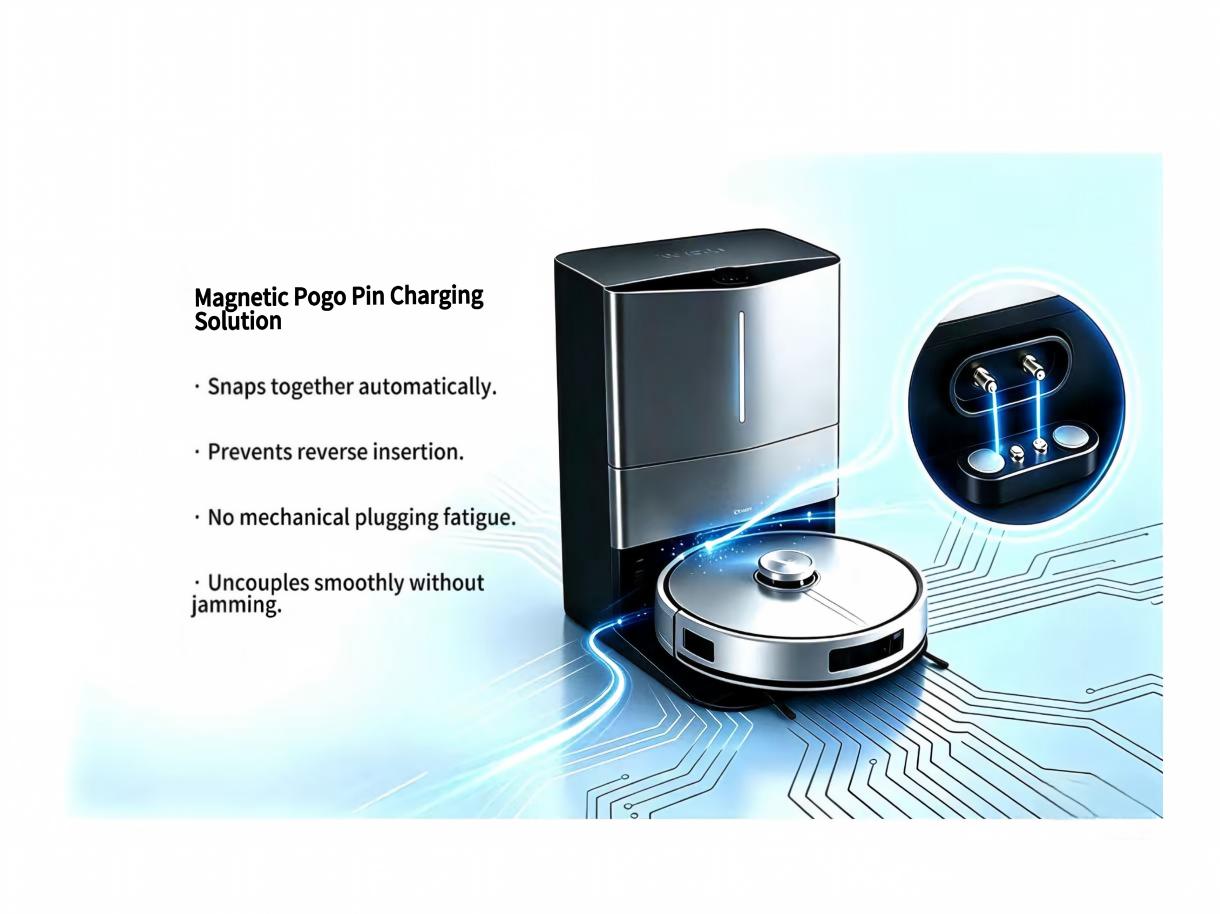
As electronic devices become smaller, thinner, and more portable, traditional connectors are not always the most suitable solution for charging and device connectivity.
Many modern products require a connection that is compact, easy to use, reliable, and capable of supporting repeated mating. This is especially important for devices that need to be charged frequently or where space for a conventional connector is limited.
Magnetic pogo pin connectors combine spring-loaded pogo pin contacts with magnetic positioning to provide a convenient connection interface. The magnetic force helps guide the mating components into position, while the pogo pins establish electrical contact.
This combination makes magnetic pogo pin connectors a practical option for a wide range of charging and connectivity applications.
What Is a Magnetic Pogo Pin Connector?
A pogo pin is a spring-loaded electrical contact designed to maintain contact with a corresponding conductive surface.
Unlike conventional pin-and-socket connectors, pogo pins do not require a traditional plug to be inserted into a socket. When the mating surfaces come together, the spring-loaded pins are compressed and maintain contact force against the opposing contacts.
When magnets are incorporated into the connector design, they can help align and hold the two mating sides together.
A typical magnetic pogo pin interface therefore combines three functions:
- Pogo pins provide electrical contact
- Magnets assist with positioning and connection
- The housing provides mechanical support and protection
This makes the technology particularly suitable for compact charging interfaces and applications requiring frequent connection and disconnection.
How Magnetic Pogo Pin Connectors Improve Charging and Connectivity
1. Easier and Faster Connection
One of the main advantages of a magnetic connection is its simplicity.
Instead of requiring the user to carefully align and insert a conventional plug, the magnetic force helps guide the two mating components together.
This can make the connection process faster and more intuitive, particularly for small devices where the connector may be difficult to see or access.
Magnetic pogo pin connectors can therefore be used for applications such as:
- Charging cables
- Charging docks
- Portable electronic devices
- Wearable devices
- Handheld equipment
- Smart home products
- Industrial handheld devices
2. Supports Blind Mating
Traditional connectors generally require the user to identify the correct orientation before insertion.
Magnetic pogo pin connectors can simplify this process by using magnetic attraction to help position the mating surfaces.
This is particularly useful when the connector is located in a recessed, compact, or difficult-to-access area.
For example, a charging dock can be designed so that the device is simply placed near the charging interface, allowing the magnetic force to help guide the contacts into position.
This blind-mating capability can improve both convenience and the overall user experience.
3. Compact Design for Space-Constrained Devices
Modern electronic products often have limited internal space.
Pogo pin contacts can be designed in compact configurations and integrated directly into a product housing or PCB assembly.
This makes them suitable for applications where a conventional connector would occupy too much space.
Depending on the product requirements, manufacturers can customize:
- Pin quantity
- Pin arrangement
- Pin diameter
- Contact spacing
- Overall connector dimensions
- Mounting configuration
- Housing structure
This flexibility allows the charging interface to be adapted to the available space within the product.
4. Suitable for Repeated Charging
Charging interfaces are often connected and disconnected many times during the product’s service life.
Because pogo pins use spring-loaded contacts, they can maintain contact pressure while accommodating small variations between the mating surfaces.
However, the actual service life of a pogo pin connector depends on its mechanical design, contact material, plating, mating conditions, and operating environment.
For applications involving frequent charging, these factors should be considered during connector selection.
5. Reliable Electrical Contact
Maintaining stable electrical contact is essential for charging and signal transmission.
The spring mechanism inside a pogo pin helps maintain contact force between the pin and the mating surface.
The contact plating is another important consideration. For applications requiring stable contact performance and good corrosion resistance, gold-plated contact surfaces are commonly used, depending on the application requirements.
Reliable performance also depends on proper alignment between the mating components.
This is where the magnetic structure can provide additional value by helping position the connector correctly.
6. Magnetic Positioning Helps Reduce Misalignment
With multiple contact points, even a small amount of misalignment can affect the connection.
Magnets can help guide the mating components toward the intended position.
However, magnetic force should be carefully balanced with the mechanical design.
The connector should provide enough magnetic attraction to assist positioning and maintain the connection, while still allowing users to separate the two sides conveniently.
Therefore, the following factors should be considered together:
- Magnetic force
- Contact force
- Mating tolerance
- Connector size
- Mechanical retention
- Required separation force
7. A Flexible Solution for Power and Signal Connections
Although magnetic pogo pin connectors are often associated with charging, they are not limited to power transfer.
Depending on the contact configuration and electrical requirements, pogo pin interfaces can also be designed to carry signals.
For example, different contacts within the same interface can be assigned to:
- Positive power
- Ground
- Data
- Control signals
- Other low-voltage connections
This allows one compact interface to combine power and signal transmission where the application requires it.
8. Suitable for Different Applications
The flexibility of magnetic pogo pin technology makes it suitable for a wide range of electronic products.
Wearable Devices
Smartwatches, fitness devices, and other wearable electronics often require compact charging interfaces with easy connection.
Portable Electronics
Handheld devices and portable equipment can benefit from a charging interface that is simple to connect and does not require a large conventional connector.
Charging Docks
Magnetic pogo pin connectors can be integrated into charging bases or docking stations for convenient device charging.
Smart Home Devices
Compact smart devices may use magnetic interfaces for charging, detachable modules, or other electrical connections.
Industrial Equipment
Portable industrial equipment can use pogo pin interfaces where space is limited or frequent connection and disconnection is required.
Medical and Healthcare Devices
Depending on the product requirements and applicable standards, pogo pin interfaces can also be considered for certain medical or healthcare electronics where compact and controlled electrical connections are required.
Key Design Considerations for Magnetic Pogo Pin Connectors
Selecting a magnetic pogo pin connector should involve more than simply checking the connector dimensions.
Engineers should consider the complete electrical and mechanical requirements of the application.
| Design Factor | What to Consider |
|---|---|
| Number of contacts | Power, ground, data, or signal requirements |
| Current rating | Required charging or operating current |
| Contact force | Electrical contact stability |
| Stroke | Available compression and mating tolerance |
| Plating | Corrosion resistance and contact performance |
| Mating cycles | Expected connection frequency |
| Magnetic force | Positioning and retention requirements |
| Connector size | Available installation space |
| Mounting method | PCB, wire, panel, or other installation |
| Environmental conditions | Moisture, dust, temperature, vibration, etc. |
| Sealing requirements | Important for outdoor or moisture-exposed applications |
A connector that performs well in one application may not necessarily be suitable for another. The design should therefore be evaluated according to the actual operating conditions.
Magnetic Pogo Pin Connectors vs. Conventional Charging Connectors
Magnetic pogo pin connectors are not intended to replace every conventional connector. Instead, they offer advantages in applications where compactness, easy mating, and repeated connection are important.
| Feature | Magnetic Pogo Pin Connector | Conventional Plug Connector |
|---|---|---|
| Connection method | Magnetic positioning + contact pins | Plug and socket |
| Blind mating | Suitable | Depends on design |
| Compactness | Highly customizable | Varies |
| Repeated charging | Suitable | Depends on connector type |
| User convenience | High | Varies |
| Customization | High | Depends on design |
| Charging applications | Excellent fit | Widely used |
The appropriate choice ultimately depends on the product’s mechanical structure, electrical requirements, environmental conditions, and user experience goals.
Custom Magnetic Pogo Pin Solutions
For many electronic products, a standard connector may not provide the required combination of size, contact configuration, magnetic force, mounting structure, and environmental protection.
A customized magnetic pogo pin connector can be developed around the specific requirements of the device.
Customization may include:
- Contact layout
- Pin size and quantity
- Magnetic positioning structure
- Connector housing
- Mounting method
- Waterproof or sealing structure
- Cable assembly
- Overmolding
- Customized dimensions
For manufacturers developing a new product, discussing these requirements at the early design stage can help ensure that the connector is properly integrated into the overall product structure.
Conclusion
Magnetic pogo pin connectors combine the electrical contact capability of spring-loaded pogo pins with the convenience of magnetic positioning.
They can provide an effective solution for products that require:
- Easy and quick connection
- Blind mating
- Compact charging interfaces
- Frequent connection and disconnection
- Reliable electrical contact
- Flexible power and signal connections
From wearable electronics and portable devices to charging docks and industrial equipment, magnetic pogo pin connectors can be adapted to a variety of applications.
However, connector selection should always be based on the specific requirements of the final product. Contact force, plating, mating cycles, magnetic force, dimensions, mounting method, and environmental conditions should all be evaluated together to achieve the desired performance and reliability.
1. What are magnetic pogo pin connectors used for?
They are commonly used for charging and power or signal connections in wearable, portable, smart, and industrial devices.
2. Are magnetic pogo pin connectors suitable for frequent charging?
Yes. Their spring-loaded contacts are designed for repeated mating and can provide stable electrical contact.
3. Can magnetic pogo pin connectors be waterproof?
Yes. With the appropriate housing and sealing design, they can be used in applications requiring water and dust protection.
4. Can they transmit both power and signals?
Yes. Different pins can be configured for power, ground, data, or other signals.
5. Can magnetic pogo pin connectors be customized?
Yes. Contact layout, dimensions, magnetic structure, mounting method, sealing, and cable assembly can be customized.
