


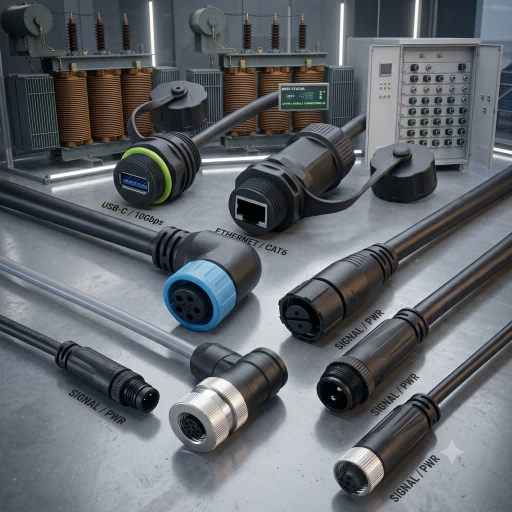
How to Choose the Right Waterproof Connectors for Outdoor Battery Energy Storage Systems (BESS)
The global demand for Battery Energy Storage Systems (BESS) is skyrocketing, driven by the rapid expansion of renewable energy grids and industrial microgrids. Since these massive battery banks are installed outdoors—often in deserts, coastal areas, or heavy industrial zones—they are constantly at the mercy of unpredictable environments.
While engineers spend countless hours optimizing battery chemistry and thermal management software, one component often holds the key to system uptime: the waterproof connector.
For utility-scale and commercial BESS installations designed to last 10 to 20 years, a standard “waterproof” rating is rarely sufficient. To ensure maximum safety and prevent catastrophic field failures, design engineers must look beyond basic product datasheets. Below are six critical, advanced technical considerations for selecting waterproof connectors and cable assemblies for outdoor BESS, followed by an essential FAQ guide.
1. The Threat of Internal “Thermal Cycling” on Sealing Integrity
Most engineers select waterproof connectors based on external ambient temperatures. However, in high-power BESS applications (such as battery-to-PCS or module-to-module links), the real threat comes from within: high-current internal thermal cycling.
When the BESS is actively charging or discharging, large currents generate significant internal heat, causing the copper contacts and surrounding materials to expand. When the system idles or cools down at night, these materials contract. This continuous mechanical movement can severely damage elastomeric seals. If a sealing ring develops “compression set” (losing elasticity after repeated heat cycles), micro gaps form, allowing moisture to penetrate the connector housing.
The solution: Specify connectors that use heavy-duty fluoropolymer or high-performance silicone gaskets, which retain elastic recovery across extreme temperature differences. Additionally, prioritize pin terminal designs with low contact resistance (such as hyperboloid or multi-finger crown bands) to minimize internal heat generation at the source.
2. Beyond IP67: Why BESS Demands Washdown and Moisture Isolation
It is a common misconception that an IP67-rated connector is sufficient for an outdoor enclosure. IP67 only guarantees protection against temporary immersion in water. In real-world BESS operations, two distinct scenarios demand superior ingress protection:
Routine Maintenance Washdowns: Over time, outdoor containers accumulate dust, sand, and pollen, which reduces cooling efficiency. Maintenance teams often clean these structures using high-pressure washdown equipment. Standard IP67 or even IP68 connectors can fail under the sheer kinetic impact of directed water jets.
Flooding & Drainage Failures: Concrete pads for BESS containers can settle, or local drainage channels can clog during heavy rain, leaving the lower cable entry points submerged for hours or days.
The Solution: For critical external interfaces, specify connectors that carry dual certifications—such as IP68 for long-term submersion and IP69K to withstand high-pressure, high-temperature washdowns.
3. Chemical Resistance and Insulation Safety in Lithium-Battery Environments
An outdoor BESS container is a closed ecosystem. Inside it, hundreds or thousands of lithium-ion cells operate at high voltages. Over years of operation, trace off-gassing from battery electrolytes (which may contain hydrofluoric acid precursors) or exposure to ambient industrial atmospheric pollutants can create a highly corrosive microenvironment.
If a connector’s plastic housing or overmolding material does not have adequate chemical resistance, its polymer structure will degrade. This degradation leads to micro-cracking, which breaks down the waterproof seal and compromises the connector’s dielectric strength (insulation resistance), raising the risk of hazardous high-voltage short circuits or ground faults.
The solution: Ensure the connector body is molded from specialized, chemically inert engineering plastics (such as high-grade PA66, PBT, or specialized alloy materials). These materials resist chemical and solvent degradation while maintaining excellent comparative tracking index (CTI) values, enabling safe handling of high voltages in humid environments.
4. Blind-Mating & Foolproof Locking for Demanding Field Installations
Even the most technologically advanced connector will fail if improperly installed in the field. BESS containers feature densely packed battery racks with severely constrained space. Technicians often have to reach deep into dark enclosures, making it nearly impossible to see whether a connector is perfectly aligned or a screw thread is fully engaged.
A partially tightened traditional threaded coupling may look fine at a glance, but it will eventually vibrate loose or fail to sufficiently compress the internal O-ring, creating an entry path for moisture.
The Solution: Transition away from traditional threaded connectors in tight spaces and adopt Blind-Mating and Quick-Locking mechanisms (such as push-pull or bayonet styles). These designs provide audible and tactile “click” feedback, ensuring technicians know with 100% certainty that the connector is fully locked and the waterproof seal is engaged—even when working entirely by feel.
5. Electromagnetic Interference (EMI) Shielding Under Wet Conditions
Inverters (PCS) and high-frequency switching power supplies inside BESS containers generate severe electromagnetic interference. While standard shielding may be sufficient under dry laboratory conditions, outdoor high humidity or thin condensation layers on structural surfaces can significantly alter dielectric constants or accelerate galvanic corrosion at shield termination points. This compromises the integrity of critical data lines (such as BMS-CAN or RS485 buses), leading to signal degradation or the triggering of system-wide faults.
The Solution: High-performance BESS signal and data connectors must feature a 360° fully shielded backshell structure that integrates seamlessly with waterproof sealing components. This ensures that shielding continuity remains completely unbroken, and prevents moisture from penetrating metal housing seams and degrading communication lines.
6. Material Selection: Metal vs. Plastic Enclosures for BESS Connectors
Choosing the right waterproof rating is only half the battle; selecting the appropriate connector housing material determines whether that seal will last 2 years or 20 years. Depending on where the BESS container is deployed—whether in a scorching desert or a corrosive coastal wind farm—the housing material faces vastly different degradation risks.
To help engineering teams balance cost, weight, and environmental resilience, the table below compares the most common high-performance materials used in industrial BESS waterproof connectors:
| Material Type | Core Strengths | Weaknesses / Risks | Ideal BESS Application |
| High-Grade Plastics (e.g., PBT, PA66 Alloy) | • 100% Rust & Corrosion Proof
• Lightweight & Cost-Effective
• Excellent Electrical Insulation |
• Vulnerable to long-term UV if not stabilized
• Lower impact resistance in extreme sub-zero cold |
Internal battery module-to-module links and controlled indoor/cabinet environments. |
| Anodized Aluminum | • Exceptional EMI Shielding
• High Mechanical Strength
• Great Heat Dissipation |
• Higher cost and weight
• Risk of galvanic corrosion if paired with mismatched metals |
High-power external container interfaces and heavy industrial microgrids. |
| Stainless Steel (316 Grade) | • Ultimate Mechanical Durability
• Highly Resistant to Salt & Chemicals
• Superior Ruggedness |
• Highest Cost
• Significant Weight Increase |
Coastal/Offshore energy storage systems and highly corrosive chemical plant environments. |
The Solution: To achieve optimal return on investment (ROI), modern BESS architectures often adopt a hybrid approach. They use rugged metal connectors with 360° EMI shielding for external panel connections, and standardize on high-quality, chemical-resistant engineering plastics inside sealed battery racks to control costs.
Frequently Asked Questions (FAQ)
Q1: Can we use standard EV (Electric Vehicle) charging connectors for static outdoor BESS applications?
A: While both handle high voltage and current, using standard EV connectors for this application is not recommended. EV connectors are designed for frequent mating cycles (durability) and manual operation, whereas BESS connectors prioritize long-term static clamping force, structural UV and chemical resistance, and higher IP ratings (such as IP69K for container washdowns). Standard EV connectors rarely meet the requirement of 15+ years of maintenance-free environmental sealing that utility-scale BESS installations demand.
Q2: How does salt spray or high salinity affect the waterproof rating of a BESS connector over time?
A: Salt spray does not immediately breach a waterproof seal, but it accelerates galvanic corrosion at the connector’s locking threads and metal interfaces. As the metal corrodes, it expands or degrades, leading to microscopic structural shifts that eventually relax the pressure on the internal rubber O-ring, resulting in waterproof seal failure. For coastal BESS installations, always specify connectors that have passed at least 480 or 720 hours of salt spray testing and feature corrosion-resistant plating (such as nickel-fluorocarbon) or high-grade engineering plastics.
Q3: Why do some connectors pass lab waterproof tests but still leak when installed in a real BESS field?
A: This issue is almost always caused by improper cable-end sealing (sealing at the cable jacket) rather than the connector interface itself. In the field, cables are often bent at sharp angles to fit into tight BESS racks. If the bend radius is too tight immediately behind the connector, it creates an uneven gap in the sealing grommet/gland, allowing water to enter. Furthermore, temperature fluctuations enable moisture to enter via capillary action (the wicking effect) from a damaged cable jacket at another location, and travel through the wire strands directly into the connector.
To prevent this problem, it is critical to adopt fully overmolded cable assemblies. Overmolding completely encapsulates the junction between the wire and the connector with molten plastic, leaving no air gaps for water to penetrate, even if the cable is bent or stressed during installation.
Partner with a Specialist in BESS Interconnect # Solutions
Optimizing an outdoor BESS for a 20-year lifespan requires an interconnect partner who understands that “waterproof” is a variable requirement, not a fixed checkbox.
At YYE, we specialize in designing and manufacturing high-performance, ruggedized waterproof connectors and custom overmolded cable assemblies tailored specifically for harsh industrial and energy storage applications. From optimizing pin-to-terminal contact resistance to custom material molding, our engineering team ensures your power and signal links stay fully sealed, no matter what environment you operate in.
Looking to secure your next BESS project? Contact us Contact the YYE engineering team today to discuss your custom connector and cable assembly requirements.
