


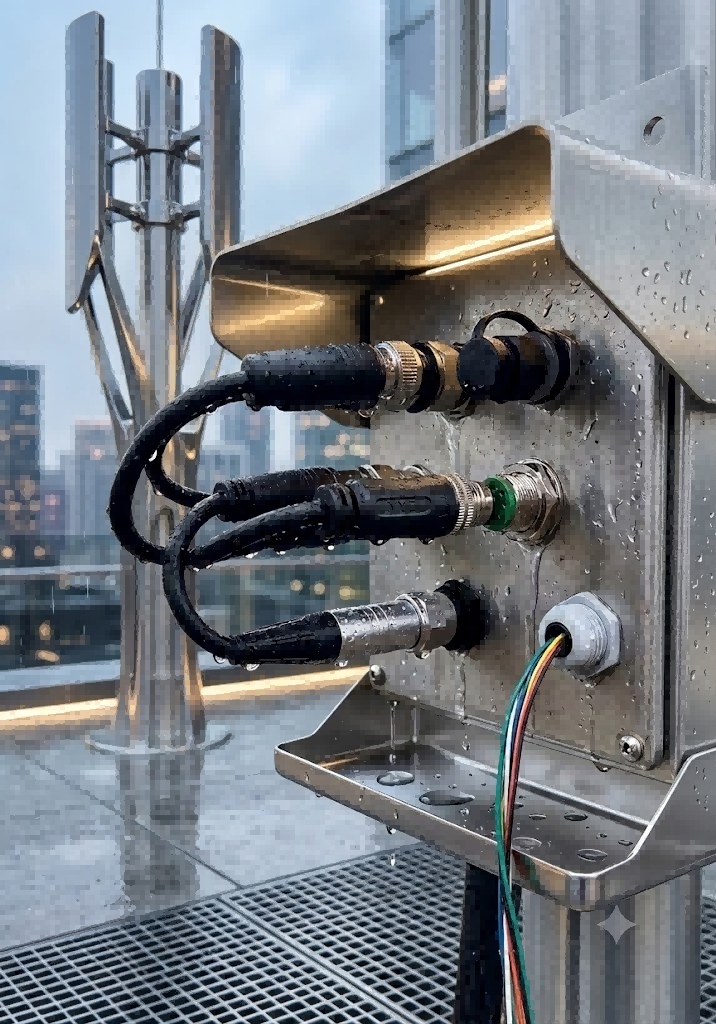
How to prevent oxidation and wear of terminals in circular connectors? Explore the effects of electroplating methods (gold plating vs. tin plating).
In demanding applications such as industrial automation, outdoor base stations, medical equipment, and new energy vehicles, circular waterproof connectors consistently serve as critical “nerve hubs.” Many believe that selecting a connector with high-standard IP67 or IP68 housing protection ensures reliable signal and power transmission without compromise.
However, industry failure analysis statistics indicate that over 60% of circular connector failures are directly or indirectly caused by oxidation and wear of internal terminals.
When connectors are exposed to environments with humidity, salt spray, high-frequency vibration, or sustained temperature rise, microscopic metal fatigue and chemical reactions persist continuously. Once a non-conductive oxide layer forms on the terminal surface or the coating wears away under mechanical stress leading to copper leakage, this can result in a sharp increase in contact resistance, signal discontinuity, and even severe safety incidents such as equipment failure or burnout.
To address this potential issue at its root, the key lies in understanding the physical properties of terminal substrates and selecting the appropriate electroplating process (gold vs. tin) during design. This article provides a thorough analysis of the underlying mechanisms behind failures in circular connector terminals and compares the performance differences among various electroplating methods, enabling you to develop highly reliable connection solutions while controlling BOM costs.
1. Why are terminal oxidation and wear the primary causes of failure in round connectors?
Circular waterproof connectors are widely used in harsh industrial or outdoor environments characterized by humidity, dust, and vibration. The combined effects of environmental erosion and mechanical stress continuously accelerate terminal oxidation and wear, ultimately leading to failure. The underlying causes can be analyzed from three perspectives: environmental conditions, operating conditions, and design/material factors.
I. Application Environment: Naturally Accelerates the Oxidation Process
Circular waterproof connectors are widely used in complex environments such as outdoor settings, coastal areas, and industrial sites, where these conditions inherently act as catalysts for metal oxidation.
- Continuous erosion by water vapor and pollutants: High humidity significantly accelerates metal oxidation reactions. Coastal salt mist, sulfides in industrial environments, and particulate contaminants further corrode the terminal coating, penetrating through coating pores or minor defects to accelerate substrate oxidation and form a non-conductive oxide film.
- Temperature fluctuations increase oxidation risks: The significant diurnal temperature variation in outdoor environments, combined with Joule heat generated by prolonged current flow through connectors, causes thermal expansion and contraction that induces minor relative displacement of terminals. This not only compromises coating integrity but also exposes fresh metal surfaces to continuous air contact, leading to secondary oxidation.
- The vicious cycle of protection failure: If the connector seal ages or is improperly installed, moisture and dust can penetrate the interface and adhere to the terminal surfaces. This not only directly promotes oxidation but also impedes heat dissipation from the terminals, further accelerating the oxidation rate.
II. Continuous mechanical operation induces wear, further exacerbating oxidation.
The typical applications of circular waterproof connectors (in automobiles, industrial equipment, and outdoor base stations) often experience vibration, which directly triggers characteristic micro-wear issues, creating a vicious cycle of “wear → oxidation → failure”:
- Micro-mechanical wear damages the protective layer: Vibration or temperature fluctuations induce micron-scale relative displacement at terminal contact points, and repeated friction removes the anti-oxidation coating on the terminal surface, exposing the underlying metal to air and leading to oxidation within a short period.
- Wear products form an insulating barrier: Metal debris and oxidation residues generated during micro-motion accumulate on the contact surfaces, forming a non-conductive insulating layer that progressively increases contact resistance, ultimately leading to unstable signal transmission and power supply interruption.
- Cumulative damage from prolonged use: Even in waterproof constructions, frequent insertion and removal can cause wear on terminal contact surfaces. Combined with wire tensioning and deformation of terminals due to installation stress, these factors further reduce contact pressure, impairing penetration through the oxide film and ultimately leading to contact failure.
III. The probability of amplifying design and selection defects
The oxidative wear failure in many circular waterproof connectors fundamentally stems from inherent flaws introduced during the selection phase.
- Inappropriate coating selection: Low-cost terminals typically use tin plating, which has poor oxidation resistance and is prone to oxidation in demanding applications; using inferior coatings with insufficient thickness or pores accelerates corrosion penetration.
- Insufficient structural design: Some products, in an effort to reduce costs, fail to incorporate adequate retention forces for high-vibration environments or incorporate anti-loosening structures, thereby accelerating micro-wear. Additionally, the terminals themselves lack reinforcing ribs, making them prone to deformation under prolonged stress and further exacerbating contact failure.
Failure statistics indicate that over 60% of circular waterproof connectors fail in outdoor and industrial environments, primarily due to terminal oxidation and wear—whether directly or indirectly. Therefore, during the selection phase, products with appropriate protection ratings and suitable coatings (e.g., gold/nickel plating) must be chosen based on environmental conditions, accompanied by regular inspection and cleaning to mitigate failure risks at the source.
2. Why is the contact material so important?
The terminal substrate serves as the fundamental physical basis that determines the reliability, conductivity, and service life of electrical connections. Its material selection directly impacts the terminal’s electrical performance, corrosion resistance, mechanical stability, and long-term safety; any defect in the substrate may lead to increased contact resistance, heat generation, or even fire hazards.
Specifically, the core function of the terminal substrate manifests in the following aspects:
A. Conductivity determines transmission efficiency and heat generation risk
The conductivity of the substrate directly determines the resistance of the terminal itself; at equal current levels, higher resistance results in greater heat generation, which can accelerate aging over time and even pose safety hazards.
Pure copper/anoxic copper: with a purity of ≥99.5% and a room-temperature resistivity of approximately 1.72×10⁻⁸ Ω·m, it exhibits optimal electrical conductivity and generates significantly less heat per unit cross-sectional area compared to copper alloys, making it the preferred choice for high-load, high-reliability applications.
Brass: A copper-zinc alloy with a conductivity approximately 80% that of pure copper, lower cost, and superior hardness and oxidation resistance compared to pure copper, making it suitable for conventional low-voltage cold-pressed terminals.
Phosphor bronze: With excellent electrical conductivity and superior strength, elasticity, and fatigue resistance compared to brass, it is the mainstream recommended material for plug-and-play connector terminals, maintaining stable contact pressure even after repeated insertion and removal cycles.
Iron/steel: With a conductivity approximately one-sixth that of copper and high resistance, they generate significant heat under identical conditions, making them suitable only as low-cost alternatives rather than for high-current applications or precision signal transmission.
B. Corrosion resistance determines the long-term stability of the connection.
The antioxidant and corrosion resistance capabilities of different substrates vary significantly, directly impacting the long-term reliability of terminals.
Copper and copper alloys inherently possess good corrosion resistance; when combined with surface coatings (such as tin or gold plating), they can maintain low contact resistance over extended periods, ensuring stable performance even in humid environments.
Iron substrates are highly susceptible to oxidation and rusting. Even with surface coatings, once the coating wears away, exposed iron rapidly corrodes, causing a sharp increase in contact resistance, which leads to unstable connections, intermittent signals, or even complete failure—particularly severe in humid environments.
The combination of different substrates can also induce electrochemical corrosion: when exposed iron substrates are paired with tin-coated copper terminals, the potential difference accelerates corrosion by more than tenfold, which is the primary cause of many furnace burnout incidents.
C. Mechanical properties affect insertion/extraction lifespan and contact pressure
The terminals must maintain sufficient elasticity and contact pressure to ensure stable connections, while the mechanical properties of the substrate directly determine their service life.
Copper alloys (phosphor bronze, beryllium copper) exhibit excellent ductility and moderate strength. Through proper alloy design, they maintain superior elasticity while sustaining adequate contact pressure even after repeated insertion and removal, resulting in longer insertion/removal life. In applications requiring high-frequency insertion/removal cycles, beryllium copper is typically preferred due to its superior elasticity and resistance to stress relaxation.
Iron/steel exhibits high hardness but poor toughness and insufficient elasticity; repeated insertion and removal can easily induce plastic deformation. Loss of elasticity may lead to poor contact and increased susceptibility to damage during the process.
D. Special scenarios impose additional requirements on the substrate
In specialized fields such as chip manufacturing, substrate selection must also account for diffusion compatibility and process suitability. For chip contact holes (Contact) that link transistors to upper-layer metals, tungsten is preferred over copper as the filling material primarily because copper tends to diffuse into silicon at high temperatures, leading to device leakage failures, whereas tungsten exhibits chemical stability, does not diffuse, and is ideal for filling ultra-small deep holes in CVD processes.
The terminal substrate forms the foundation for all performance characteristics. Industry mainstream standards consistently prioritize copper or copper alloys as terminal substrates, while iron-based materials are used only in scenarios where cost is critically important and performance requirements are minimal. In applications such as home decoration and industrial control, selecting copper-based terminals that comply with national standards may incur slightly higher initial costs, but it helps avoid substantial maintenance expenses and safety risks arising from poor contact quality later on.
3. Why is electroplating necessary for terminals?
Terminal electroplating is a process that deposits a metal coating on the surface of terminal substrates using electrochemical methods. Its primary purpose is to enhance reliability and electrical performance while extending terminal service life, making it a critical step in connector manufacturing that determines final performance.
From an engineering perspective, the core value of terminal electroplating lies primarily in the following aspects:
A. Isolation corrosion – protecting the substrate
The substrate materials for terminals are primarily copper alloys such as brass or purple copper. These materials are highly susceptible to oxidation and sulfidation reactions in the air, generating corrosion products with high resistivity that progressively increase contact resistance, ultimately leading to connection failure. Following electroplating, a corrosion-resistant coating isolates the substrate from the operating environment, thereby preventing corrosion at its root cause.
B. Optimize the contact interface to stabilize electrical performance
The copper oxide formed on the surface of bare copper exhibits a resistivity as high as 5×10^8 Ω·m—nearly 10^15 times that of pure copper—which significantly increases contact resistance and poses safety risks due to overheating during high-current operation. By selecting an appropriate electroplated coating, stable metal-to-metal contact can be achieved.
Precious metal coatings such as gold and palladium inherently lack oxide films, enabling direct formation of stable, low-resistance contacts.
The oxide films on non-precious metal coatings such as tin and lead are prone to rupture during insertion and removal, yet they can still establish stable conductive regions.
Gold plating and silver plating can further reduce the overall impedance, meeting the requirements for low-impedance, high-current, or high-frequency signal transmission.
C. Improve mechanical performance and extend service life
Different coatings can specifically enhance the mechanical properties of terminals:
The nickel coating exhibits high hardness and excellent density. As a base layer, it not only enhances overall wear resistance but also prevents the diffusion of copper from the substrate to the surface noble metal, thereby extending the service life of the entire coating.
An appropriate coating combination can enhance insertion/extraction durability, reduce wear during operation, and lower the risk of failure over prolonged use.
D. Improve process performance to meet production requirements
Electroplating also enhances the subsequent processing performance of terminals:
For tin plating in the welding area, it significantly enhances the adhesion of the base material to tin and markedly improves weldability, making it suitable for automated welding production.
For substrates with poor adhesion, pre-coating them with copper as a base layer enhances the adhesion of subsequent coatings and improves mass production yield.
E. Appearance Optimization
The electroplated terminal surface is brighter and smoother, offering both aesthetic appeal and ease of visual quality inspection.
4. Key Differences Between Gold Plating and Tin Plating
The gold plating and tin plating processes exhibit fundamental differences in terms of oxidation resistance and wear resistance, requiring a comprehensive evaluation of both performance and cost when making decisions.
Gold plating vs tin plating: Key differences in oxidation resistance and wear resistance
The performance differences between the two coatings stem from the inherent properties of the metals themselves, directly determining their service life in circular connectors.
| Performance Dimension | Gilded connector | Tin-plated connector |
| oxidation resistance | Extremely stable; the chemical properties of gold are highly consistent, with almost no reaction with substances in the air, and no oxidation issues occur even after prolonged use. | The chemical properties of tin are relatively weak; it is highly reactive and readily oxidizes to form an oxide film upon exposure to air. The oxidation rate significantly increases under high humidity or salt spray conditions. |
| Wear resistance / Insertion/drawing life | Excelling performance: the alloy-plated gold has moderate hardness, with a conventional insertion/pulling cycle life of 5,000–10,000 cycles; for high-thickness specifications, it exceeds 100,000 cycles. | Generally, tin coatings are relatively soft, with a typical insertion-extraction cycle life of only 1,000–5,000 cycles; frequent insertion-extraction may wear through the coating and expose the underlying substrate. |
| contact resistance | Extremely low (typically ≤5 mΩ), long-term stable, with minimal signal/current transmission loss | At higher values (10–50 mΩ), the contact resistance increases further after oxidation, which may lead to temperature rise issues. |
| prime cost | The cost is relatively high, typically 3 to 10 times that of tin-plated connectors with the same specifications; the greater the thickness, the more pronounced this cost difference becomes. | Affordable with outstanding cost-effectiveness, ideal for mass production |
5. Under what circumstances should gold plating be chosen?
Selection Strategies for Different Scenarios (Preventing Oxidative Wear at the Source)
The key to preventing oxidative wear on round connector terminals lies not in blindly pursuing high-cost gold plating, but in matching them to specific application requirements.
- Prioritize gold-plated scenarios
If your circular connector meets any of the following conditions, we recommend prioritizing the gold-plating option:
A: High-frequency insertion/ removal requirements: For test equipment requiring frequent disassembly and assembly or field-replaceable modules, the gold plating thickness should be at least 0.75–1.25 μm (30–50 μin) to withstand thousands of insertion cycles without wear.
B: Applications in harsh environments: suitable for outdoor industrial equipment, coastal projects, and chemical applications operating in humid/salt spray/corrosive conditions. A high-thickness gold plating layer (≥1.25 μm) provides robust barrier protection, completely blocking oxidation pathways.
C: High reliability requirement: For critical systems such as aerospace, medical devices, and energy storage BMS, gold plating ensures long-term stable low contact resistance even under frequent insertion/ removal cycles, eliminating failure risks caused by oxidation.
D: Small signal/low-voltage transmission: Under low-voltage conditions, the oxide film cannot be broken down, leading to intermittent transmission issues; the chemical inertness of gold plating eliminates this problem.
Note: Gold plating typically requires a nickel-based primer; it is recommended to use products with a nickel layer thickness of ≥1.25 μm (50 μin). The nickel layer prevents copper from diffusing from the substrate into the gold layer while enhancing overall wear resistance and corrosion resistance of the coating.
6. Under what circumstances should tin plating be selected?
Suitable for applications requiring tin plating
Tin plating is a more cost-effective option and effectively prevents oxidation if the following conditions are met:
A: Static fixed connection: Suitable for applications where the device remains installed without disassembly over extended periods—even under high current loads—as long as the environment is dry and free from corrosion, tin plating fully meets all requirements.
B: Cost-sensitive batch production applications: In scenarios requiring stringent cost control—such as consumer electronics and general-purpose household devices—tin plating offers superior soldering performance, is ideal for automated mass production, and significantly reduces manufacturing costs.
C: Conventional drying environment: Free from harsh conditions such as high temperature, high humidity, salt spray corrosion, or vibration; the inherent oxidation resistance of tin plating is sufficient to support the product’s entire lifecycle.
Note: For applications involving vibration (e.g., automotive, marine, or motor equipment), tin-plated round connectors are not recommended—vibration causes micro-wear that gradually erodes newly exposed tin layers, ultimately leading to tin oxide buildup and poor contact. This issue is particularly pronounced in high-current connectors.
In addition to selecting the appropriate coating, two key measures can prevent oxidative wear in round connectors at its source: prioritize models with sealing structures. In environments that are inherently humid and dusty, opting for waterproof sealed round connectors effectively blocks external moisture and contaminants, significantly reducing oxidation rates—even extending the lifespan of tin-plated terminals substantially.
Pay attention to plating thickness specifications: Avoid low-cost products without specified gold plating; for industrial applications, opt for at least 4 μin (0.1 μm) gold plating, and for high-reliability scenarios, a minimum of 4 μin is recommended, ensuring a plugging/drawing cycle life exceeding 2,000 cycles.
Avoid mixing different coatings: Do not pair gold-plated and tin-plated male/female terminals, as differences in metal electronegativity can cause electrochemical corrosion and accelerate oxidation failure.
7. FAQ
Q1: How should I balance housing sealing (IP protection) and terminal electroplating in a circular connector?
The housing seal protects against external environmental factors, while terminal electroplating safeguards against wear from insertion and removal. If the connector housing provides excellent sealing and is not frequently disassembled, low-cost tin plating suffices for internal terminals; however, when the connector requires frequent insertion and removal, where each cycle compromises the seal, gold-plated terminals resistant to wear and oxidation must be employed to ensure signal stability.
Q2: Given that gold offers the best electrical conductivity and oxidation resistance, why not gold-plate all terminals of circular connectors?
This decision is primarily based on cost considerations and practical operating conditions. Full gold plating significantly increases procurement costs for large-scale production. Moreover, in applications requiring high current flow, intense contact pressure, and infrequent plugging and unplugging—such as automotive power systems or heavy machinery—the substantial mechanical force can strip the surface oxide layer of the tin plating to maintain adequate conductivity; thus, gold plating would represent an unnecessary performance enhancement in such scenarios.
Q3: For circular connectors already in use, what routine maintenance practices can extend the lifespan of the terminals?
The most effective maintenance procedure involves applying a very thin layer of specialized electronic contact lubricant to reduce friction and prevent oxidation. Additionally, when cleaning terminals, the use of sandpaper or hard-bristled brushes is strictly prohibited to avoid damaging the micron-scale electroplated coating; instead, anhydrous alcohol and cotton swabs should be employed for wiping. Finally, when the connector is not in use, the accompanying dust cover must be securely tightened to isolate it from air exposure.
The terminal protection of circular connectors essentially involves a trade-off between environmental erosion, mechanical wear, and manufacturing costs. There is no absolutely perfect electroplating material; only engineering decisions that best suit the specific application conditions exist.
Gilding is the absolute preferred solution for high-frequency insertion and removal, harsh environments (high humidity/salt spray), low-voltage small signals, and high-reliability core systems. When combined with a standardized nickel-plating process, it effectively prevents copper atom diffusion, extending the insertion/removal cycle life and resistance to micro-wear to over several thousand cycles.
Tin plating is the optimal choice for static fixed connections, conventional indoor dry environments, and cost-sensitive mass production applications due to its superior cost-effectiveness. With excellent soldering performance, it remains reliable even under high-voltage, high-current conditions where frequent insertion and removal are rare.
In practical project development, in addition to focusing on coating materials, it is essential to ensure that male and female terminals are matched with “gold-to-gold, tin-to-tin” pairs to prevent electrochemical corrosion, and to strictly verify the supplier’s specified coating thickness values. By incorporating detailed environmental and operational condition assessments during the selection phase, combined with necessary subsequent dust-proofing and lubrication maintenance, you can not only minimize connector failure rates but also establish a robust foundation for the long-term stable operation of the entire system.
Looking for professional connector solutions? Contact us!
When dealing with complex industrial, automotive, or outdoor operating environments, proper terminal selection and electroplating configurations often require precise technical evaluation. Whether you’re experiencing frequent connector failures or unstable impedance, or need to determine the most cost-effective electroplating solution for a new project, our experienced engineering team stands ready to assist you.
We not only provide high-quality circular waterproof connectors compliant with international standards, but also offer customized terminal electroplating solutions and technical drawings tailored to your specific application requirements (e.g., high-frequency vibration or highly corrosive environments).
Feel free to contact us for free sample testing, technical consultation, and a formal quote. Let’s work together to ensure seamless connectivity for your equipment!
